
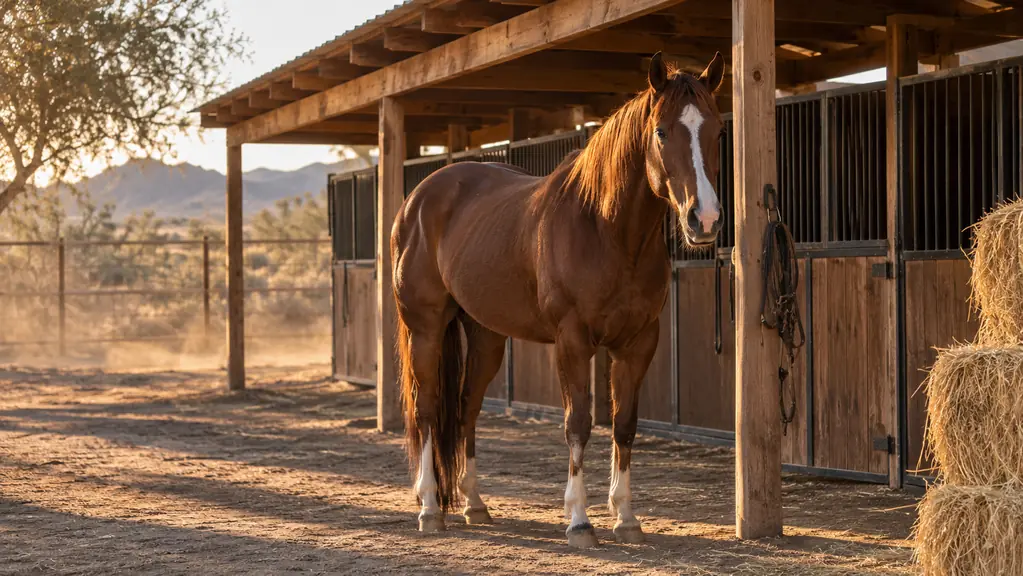
Fly season outside Scottsdale does not arrive politely. It shows up in the middle of a June afternoon, when the air goes still and the first stable flies find the inside of a horse's hind leg. On my place it is always Nadia who tells me first. She is a 9-year-old bay Arabian mare with a thin coat and a low tolerance for anything that buzzes, and when the flies are bad she will not stand still in the wash rack long enough for me to pick up a hoof. My gray gelding Sahir is tougher, but even he will stamp and swish through an entire ride if I have not stayed ahead of it. What has actually changed my summers is not a stronger spray. It is a plain, disciplined routine built around Farnam Endure, applied correctly rather than often. Here is that routine, step by step, in the order I do it.
Most people who tell me fly spray does not work are using it as a reaction instead of a schedule. They see flies, they spray, the flies come back in two hours, and they conclude the product is weak. What usually happened is that the spray went on over dirt and shed hair, it went on as one wet drench that ran off down the shoulder, or it went on at nine in the morning with the expectation that it would still be there at five in the afternoon. Endure is labeled for up to 14 days of protection and uses a technology the label calls Repelock, which binds to the hair shaft. That is a different promise than a knockdown spray makes. It is still a promise that depends entirely on how you put it on. The bottle does its part. The steps below are yours.
The 14-day label only holds if the spray stays on the hair
Farnam Endure is a permethrin fly spray labeled for up to 14 days of protection, with Repelock technology that binds to the hair shaft. It kills and repels house, stable, face and horn flies. Check today's price on Amazon.
Amazon Check Today's Price on Amazon →Step 1: Pick Your Window, Not Your Fly
The mistake I see most often is spraying a horse that is already covered. Flies that are on the animal when the spray lands will move, and the ones that leave come back within the hour. Spraying earlier is not about using more product. It is about the flies never getting a foothold in the first place. On my place that means the window between the morning feed and the first real heat, somewhere around seven and eight, when the horses are still quiet, the air is still moving, and nobody has started swishing yet.
Watch the weather, too. Desert summers here are dry enough that rain is rarely the problem, but the late-summer monsoon changes things. When the humidity climbs and the dust storms roll through, the horses sweat more standing still than they do in June, and sweat is what shortens the life of any spray on the hair. If a storm is forecast for the afternoon, I would rather spray the next morning than put a full application on a horse that is going to be wet four hours later. The dust itself matters as well. A horse that has been out in a blow comes in with grit worked into the coat, and grit is the enemy in step two.
One more thing about timing. Do not spray a hot horse straight off a ride. The coat is damp, the hair is clumped, and the application goes on unevenly because you are spraying over sweat instead of clean hair. Let the horse cool and dry, then spray. It costs you twenty extra minutes and it is the difference between coverage that lasts and coverage that is gone by evening. I learned that one on Sahir, who comes back from a summer trail ride looking like he has been through a sprinkler.
Step 2: Start With a Genuinely Clean Horse
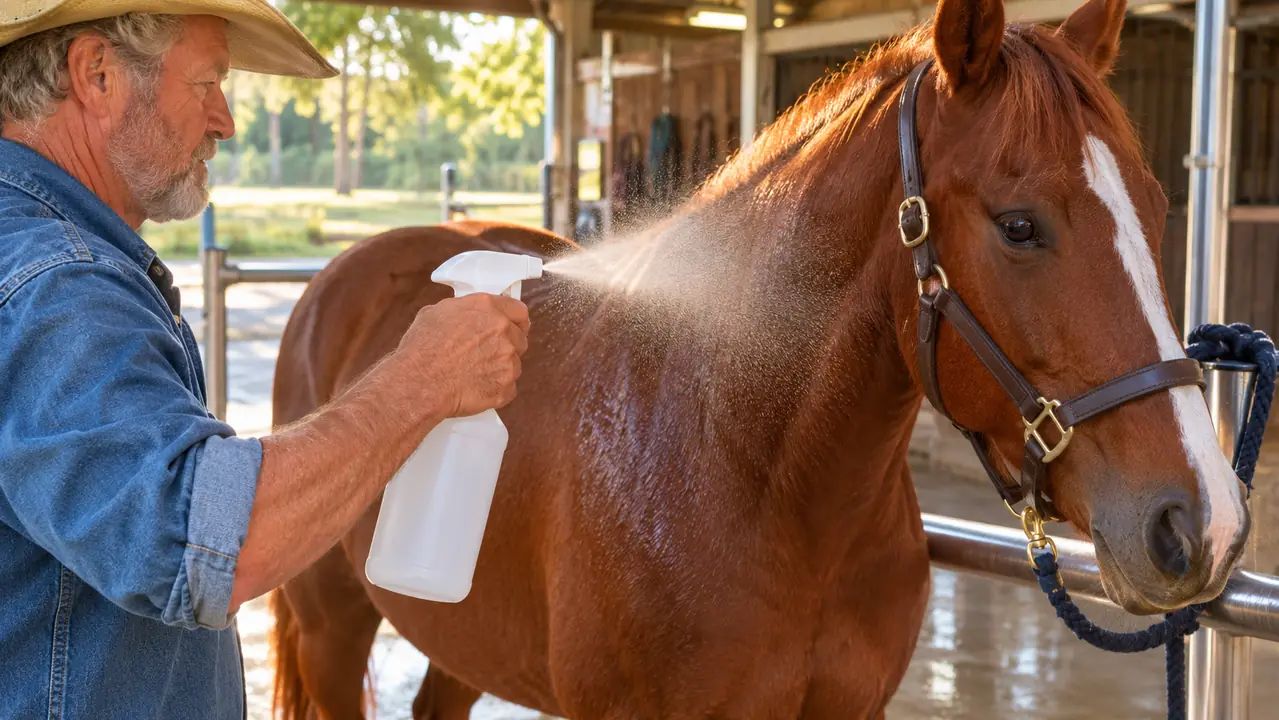
Farnam Endure binds to the hair shaft. That is the whole idea behind the extended protection, and it is also why a dirty coat wastes your money. Dust, dried sweat, loose hair and grooming residue all sit between the spray and the hair it is supposed to attach to. I curry first, then brush, then go over the coat with a rag if the horse has been out in the dust. Only then do I spray. It adds about ten minutes per horse and it is the single cheapest improvement you can make to a fly control routine.
Sahir is a gray, and gray horses show every bit of dust they collect, which is useful because it tells me when he needs more than a quick once-over with a soft brush. Nadia is the opposite problem. She is thin-skinned, she resents a stiff brush, and she will fidget if I rush her. With her I use a soft brush and take the time, because a horse that is dancing around while I spray gets an uneven application and I have wasted both the product and the ten minutes. There is no version of this where hurrying a sensitive mare pays off.
If you bathe before you spray, the coat has to be genuinely dry, not dry to the touch. A horse that feels dry across the shoulder can still be damp underneath at the flank and the girth area, and that damp patch is where the coverage fails first. In show season I bathe the evening before and leave the horses in the paddock overnight, then spray the following morning once the sun has been on them for an hour. It sounds fussy. It is also the biggest single improvement I have made to how long a bottle lasts around here.
Step 3: Apply It in Layers, Not Puddles
Hold the spray about eight to ten inches off the coat and work against the direction the hair grows, in short passes. You are trying to lay down a light, even film that reaches the skin, not a wet stripe. If the coat starts looking dark and plastered flat, you have gone too far and a good part of it is going to run off or dry into a crust that does nothing. Two light passes over the same area beat one heavy one every time, and it uses less of the bottle.
Work in sections. Shoulder, barrel, flank, hip, then down each leg. I do the near side, walk around, then do the off side. It is slower than standing in one spot and swinging the bottle around, and it means the horse never gets a cold hit in the same spot twice in a row, which matters with a mare like Nadia who will step away from a sudden wet shock and take the rest of the application with her. Tie the horse short enough that she cannot swing her hindquarters into you, and long enough that she can relax her head.
On the face, do not spray directly. I put a little on a cloth and wipe the forehead, the bridge of the nose and around the ears, keeping it well out of the eyes and out of the nostrils. Same method for the inside of the hind legs and the sheath on a gelding, which is exactly where the stable flies go first and exactly where a direct spray will earn you a kick. A cloth is slower. It is also the only way I do those spots, and I have never had a horse object to it.
Step 4: Cover the Places Flies Actually Land
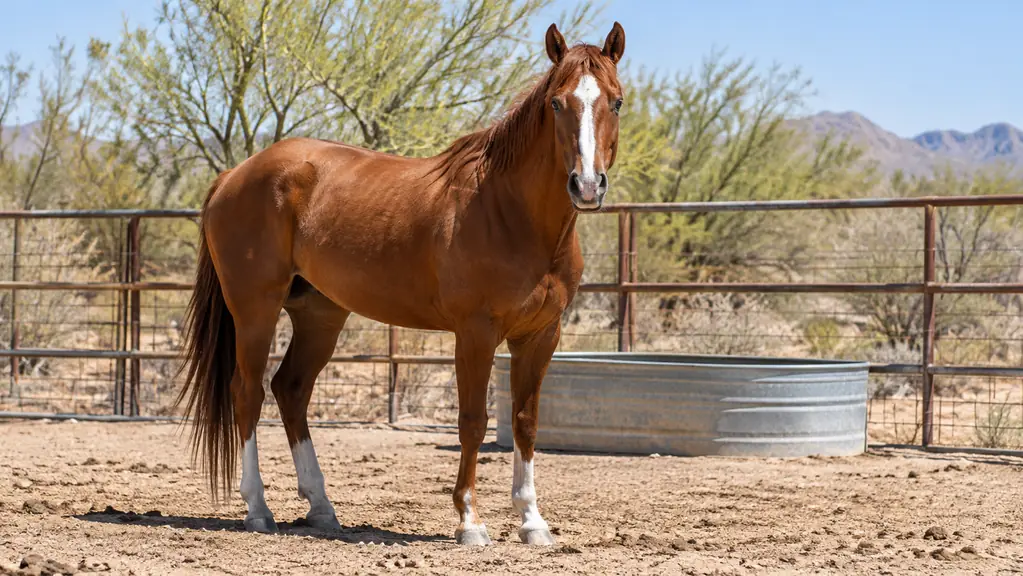
Flies do not land evenly. Stable flies work the legs and the belly line. House flies gather around the eyes, the muzzle and any small nick or scrape. Horn flies sit in a cluster on the back and shoulders. Face flies go straight for the tear ducts. If you spray the neck and the rump and call it finished, you have covered the two places flies care least about and left the four places they care most about completely open.
My order is legs, belly midline, chest and throatlatch, then the topline, then the face with a cloth, then a light pass over the tail dock. The tail dock gets skipped constantly and it is where horses rub themselves raw by August. Kasim, who is 22 and retired, stands in the same paddock all day and cannot walk away from a fly, so he gets the belly and the legs done more carefully than the two riding horses. He also gets them checked every evening, because he will not tell me until a spot is already sore to the touch.
Legs are worth the extra minute. Spray from the knee down, get the back of the cannon bone and around the coronet band, and do not forget the inside of the hock. That is where I find the first stamped, raw patches of the season if I have been lazy about it, and once a horse starts stomping, no amount of spray on the shoulder is going to settle him down.
Step 5: Track the Clock and Reapply Before the Flies Tell You
The label says up to 14 days. Write the date on the barn board when you spray, because you will not remember four days later and you will convince yourself you did it recently. Fourteen days is the ceiling on a clean, dry coat in decent conditions, and desert August is not decent conditions. Heat, sweat and dust all shorten it, and a horse that has been worked hard is going to need a touch-up well before a horse that has been standing in the shade doing nothing.
My rough schedule in the worst six weeks of the season: a full application every ten days, plus a spot touch-up on the legs and belly around day five or six for Nadia and Kasim. Nadia because she reacts to the first fly she feels, and Kasim because he cannot get away from them. The label is a maximum, not a guarantee. Treating a maximum as a guarantee is how people end up deciding that fly spray does not work.
Sweat-resistant is not sweat-proof. If a horse comes in soaked after a ride, the coverage on the barrel and the girth area is going to be reduced, whatever the label says. I redo those areas rather than the whole horse, which is the practical reason to be precise about where you spray in the first place. A bottle of Farnam Endure goes a long way when you are touching up a horse rather than starting over on one.
One more habit worth building. I keep a second 32 oz bottle in the trailer for show days, because the morning of a show is exactly when I am rushed and most likely to skip the legs. A bottle in the trailer means the horses get sprayed at the grounds before they go in the ring, and it means I am not borrowing someone else's while my own horse stomps in the warm-up area.
What Else Helps
Spray is one layer of a system, and it stops working if the other layers are missing. Flies breed in manure and wet bedding, so I pick the paddocks and the pasture every day in season and haul the wheelbarrow to the pile instead of letting it sit by the barn door. I keep the water troughs clean and the ground around them from going sour, because damp dirt draws them. Air movement helps more than people expect. A fan in the barn aisle on a still afternoon will keep flies off a tied horse better than a second coat of anything, and it costs nothing to run.
I also use fly masks on all three during the day and pull them at night, and I time turnout so the horses are in the shade through the worst of the afternoon rather than standing in full sun in a dry lot. Masks do more for face flies than any spray I have tried, mostly because the spray cannot go where the flies are going. None of this replaces the spray. It reduces how much the spray has to do, and that is the difference between a summer you manage and a summer you spend fighting.
The last thing I would say is to be consistent rather than intense. A moderate application every ten days, on a clean coat, in the right places, will beat a heavy soaking once a month every single season. Farnam Endure gives you the window. The routine is what keeps it open, and by mid-July you will know whether you have one.
Fourteen days means fourteen days on a clean, dry coat in decent conditions. On a dusty horse in a monsoon August, you will get less, and that is not the bottle's fault.
The flies will be back in ten days. Be ready before they are.
Farnam Endure comes as a 32 oz spray, labeled for up to 14 days of protection against house, stable, face and horn flies. One bottle covers a small barn through the worst of the season. Check today's price on Amazon.
Amazon Check Today's Price on Amazon →