
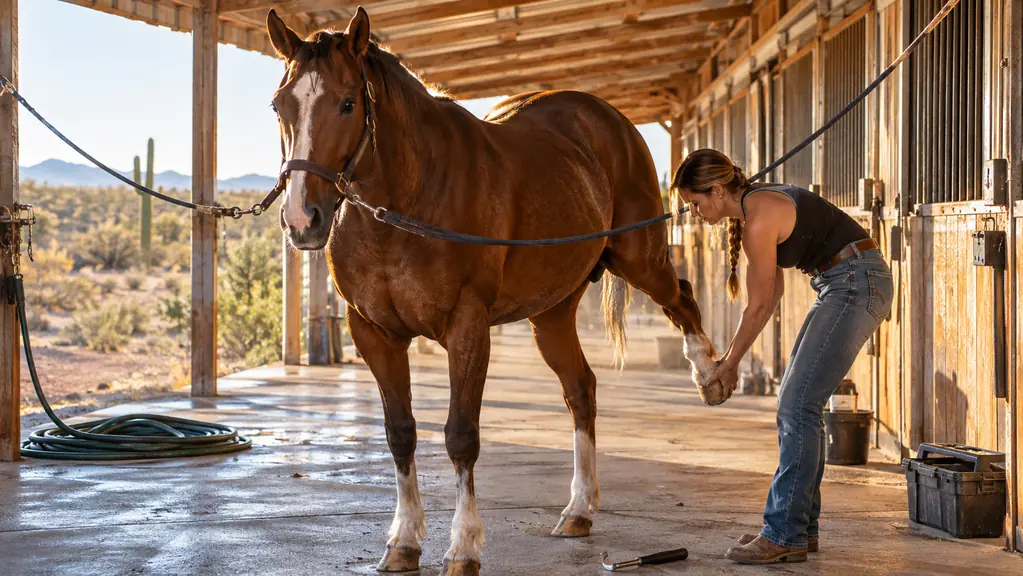
Kasim is 22 this spring. Chestnut Arabian gelding, retired four years, and his hooves have always been the fragile part of him. Nothing dramatic like laminitis. Just dry. The kind of wall that chips along the bearing edge and reopens the same hairline crack at the toe every August, right when the monsoon dust starts and the ground goes from baked to muddy and back.
If you keep Arabians out here, you have likely tried the obvious fixes. A dressing you paint on once a week and forget. Waiting for winter. Blaming the farrier. I did all three over about three years. None of them touched the real problem, which is that a dry hoof loses moisture faster than a desert gives it back. What has worked for two years now is Farnam's deep-penetrating hoof conditioner, the 32-ounce liquid, on a fixed schedule. This is the routine.
The difference between a dressing and a conditioner is where it ends up
Farnam's 32-ounce formula is a liquid that penetrates the hoof wall and carries avocado oil and glycerine down to the coronary band, where the hoof actually grows from. Pine scented, pine tar free, rated 4.8 across roughly 1,500 reviews. It is the one container in my tack room I replace before it runs out.
Amazon Check Today's Price on Amazon →Step 1: Read the Hoof Before You Buy Another Product
The first thing I do with a foot that is chipping is stop buying things and start looking. Pick it out heel to toe, brush the sole off, set it down, and look at the wall in good daylight. Dry horn, not horn you just hosed. What I want to know is where the damage starts. A crack that opens at the ground and runs up is usually mechanical, thin wall meeting hard ground. A crack that starts at the coronary band and runs down is a growth problem. They look similar in a photograph and they are not the same thing.
Kasim has both, which is why his was stubborn. He has a thin wall on the outside of both fronts, and at 22 he grows hoof slower than he did at 15, so the wall chips at the bearing edge and the toe crack reopens before it ever grows out. Nadia is the opposite case and she taught me the most. She is 9, she has never had a crack in her life, and her problem was me. She is thin skinned, the flies bother her badly in late summer, and I was hosing her feet three or four times a week to keep the dust and manure off. I was creating the very cycle I was trying to fix.
So before you buy anything else, write down four things for each foot: where the crack starts, what the bearing edge looks like, how the coronary band feels, and how many times that foot gets wet in a week. That last one is the one people skip, and it is usually the answer. A horse that lives on dry lot in June is fine. A horse that goes irrigated pasture, dust, wash rack, dust inside the same week is not, and no topical product will outrun that.
Step 2: Clean the Foot and Let It Dry, So the Conditioner Can Get In
The conditioner is a liquid and it works by penetrating. That means the hoof has to be clean enough and dry enough to take it. My order is pick, scrub, rinse, towel, wait. Pick the foot out completely, including the commissures beside the frog. Scrub the sole and the wall with a stiff brush and plain water, no soap, because soap residue does not lift desert dust out of a hoof and shampoo is one more thing drying it. Rinse it clear, towel it, and let it stand for twenty minutes.
Twenty minutes sounds fussy. It is not, and it is the step I skipped for a year. Conditioner on a soaking wet hoof dilutes and runs off. Conditioner on a hoof still packed with dust makes mud in the crevices. Dry horn takes the product in, and you can feel the difference with your thumb when it does.
Timing matters as much as preparation. I do feet after work, not before. Condition first and then ride in the arena, and you have given the sand something to stick to. Evening, after the last ride, with the horse on a clean mat, is the easiest version of this routine to keep for years instead of weeks.
Step 3: Put It on the Coronary Band, Not Just the Outside Wall
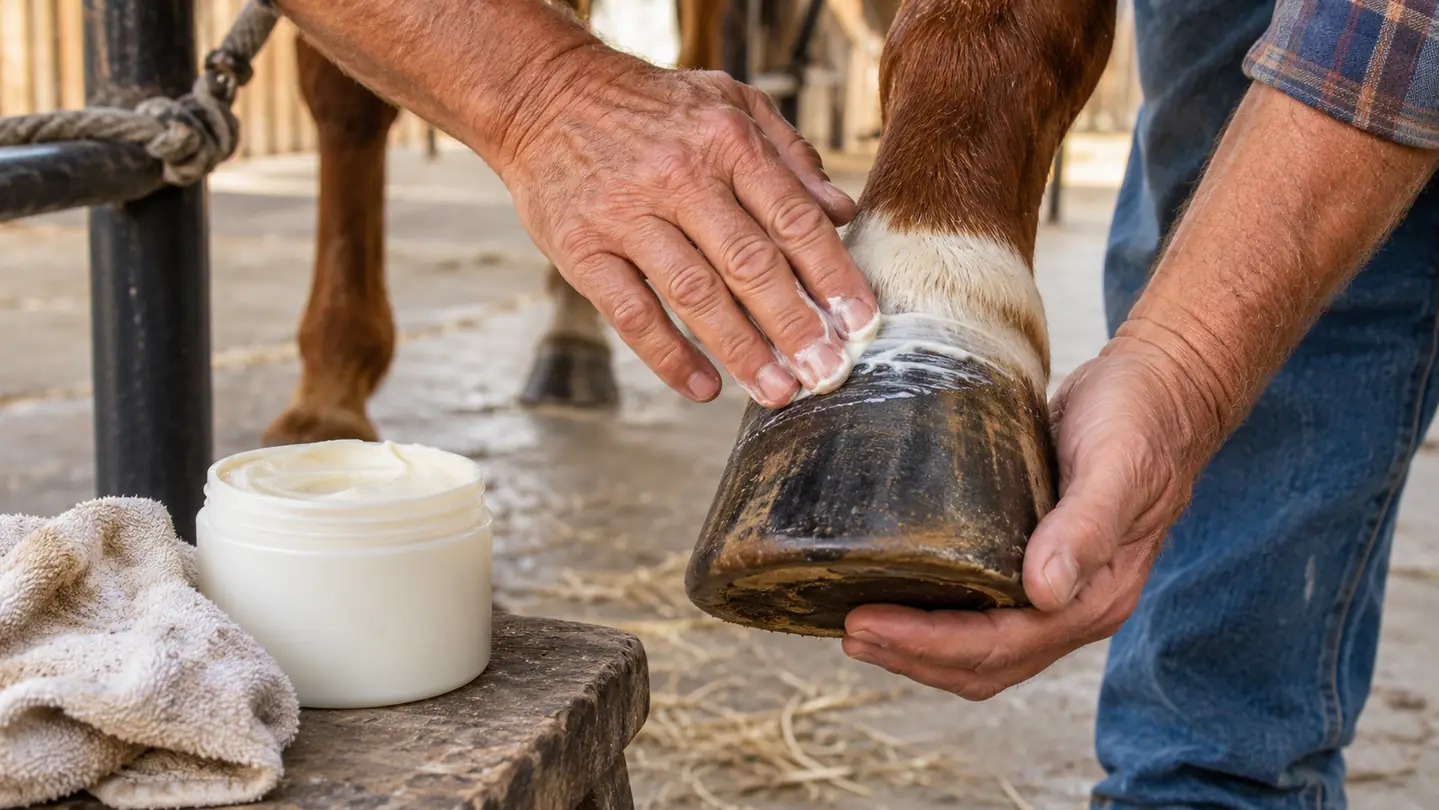
Pour a little of the conditioner into a shallow pan rather than over the hoof, because a liquid in a 32-ounce container keeps coming and you will lose half of it in the straw. I use a rag for the wall and a cheap chip brush for the area right above the hoof. Start at the coronary band, the hairline where the hoof meets the skin, work down the wall to the ground, then press a little into the sole and around the frog. Both fronts, both hinds, every time, including the ones that look fine.
The coronary band is the whole point. Hoof grows down from there, and Farnam's formula is built to penetrate at that band and stimulate collagen production, which is where a stronger wall actually comes from. Painting the outside of a dry wall and stopping is waxing a car with a bad frame. The band is also the best early warning you get. If it feels hot, if the hair stands up, or if the horse flinches away, stop and call your vet, because that is not a dryness problem.
One honest note on the smell. It is pine, and it is strong enough that Kasim turns his head and looks at me. Pine tar free, which I care about with dust sitting on everything from July on. It goes on wet, soaks in within a few minutes, and does not need a wrap, a boot or a bandage. He goes back out on dry lot twenty minutes later and nothing rubs off on the fence.
Step 4: Put It on a Schedule You Will Actually Keep
The schedule I keep is twice a week in summer and once a week from November through March. Kasim gets a third application on the fronts during monsoon season, because his wall is thin and the ground goes from hardpan to wet and back inside a week. Nadia gets once a week year round. Sahir, who is 14 and has the best feet of the three, gets whatever is left on the rag, which is not a schedule at all but it has kept him sound.
The anchor for all of it is the farrier. He comes every six weeks, so I count backwards from that date. Two weeks out I step up the fronts and write down what I see. The night before he comes, I condition and take a photograph of each foot on my phone. Six weeks later I have a fair comparison instead of an impression, and my farrier gets to look at a photo instead of listening to me guess.
Consistency beats intensity, and I learned that the expensive way. Three panic applications in one week does nothing. Twice a week for four months does. Miss a week and you have not ruined anything. Miss a month in July and you will see the chipping return inside one farrier cycle, which is exactly what happened to me the first August I traveled.
The August my farrier set Kasim's front feet without mentioning the toe crack was the first time in three years. Nothing dramatic caused it. I just stopped missing weeks.
Step 5: Take Away What Is Drying the Hoof Out
You can condition a hoof twice a week and still lose the fight if you are drying it out five days a week. Stop hosing feet for appearance. A dusty hoof is a normal hoof. I use the wash rack on Kasim's legs and feet only when there is actual manure packed into a crevice or he is coming off a muddy trail ride, and then I dry him properly instead of turning him out wet.
Look at the ground the horse actually stands on. My dry-lot paddocks are hard and dusty by June, and the irrigated pasture is soft from July through September. A horse that goes back and forth in the same day is cycling, and cycling is what cracks walls. I pick one for the day and leave him there. The monsoon dust storms are the worst of it, because everything goes from powder dry to soaked in about an hour.
And look at the footing under the water trough. Half the dry hooves I have seen in this valley were made by a horse standing in mud to drink and then standing on baked ground to sleep. Gravel or a mat under the trough, plus a board to keep the splash off, is a cheaper fix than anything you can buy off a shelf.
What Else Helps
Water and salt. A brittle hoof is partly a hydration problem, and a horse that will not drink in July is not going to grow a supple wall no matter what you put on the outside. Kasim has loose salt in front of him year round and I float his hay when it is over 105 degrees. Ask your vet how much water your horse should be moving, especially an older one.
Feed the wall you want. Hay analysis is not a hobby I picked up for fun, but the gap between good and marginal hay in this part of Arizona is real, and biotin and zinc are the two things my farrier asks about first. I do not chase every supplement on the shelf. I make sure the basics are covered, because a topical conditioner sits on top of nutrition and never in place of it.
Get your farrier on your side. Tell him what you are using, how often, and what you have seen since last time. Mine adjusted Kasim's trim slightly once the wall got stronger, and that is a conversation you can only have if you both know what changed. If a hoof is hot, if there is a digital pulse, or if the horse is lame, that is a vet call. Conditioner is for dry, brittle horn. It is not a treatment for laminitis, an abscess or a metabolic problem.
Twice a week from now on, not once a month in a panic
The 32-ounce container of Farnam's deep-penetrating conditioner is the piece of this routine that does the work, and it goes a long way at two applications a week across three horses. It goes in at the coronary band, it needs no wrap, and it has kept my 22-year-old's front feet uneventful for two summers running.
Amazon Check Today's Price on Amazon →