
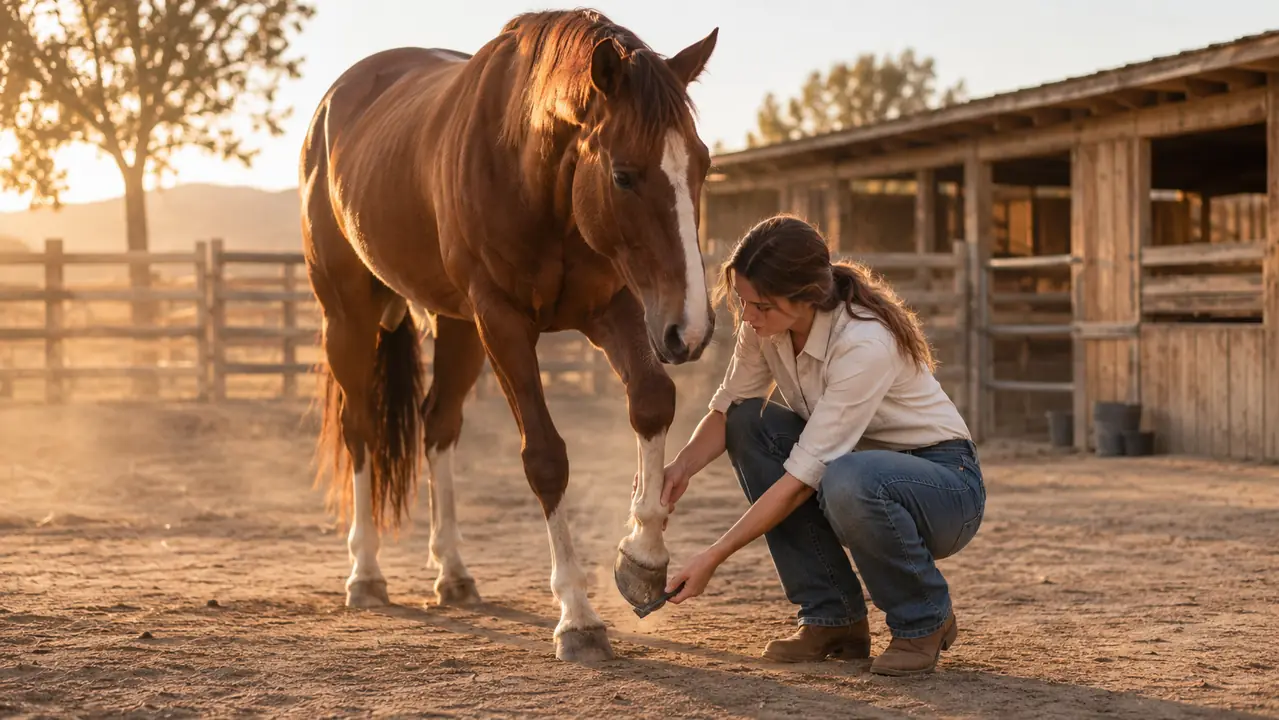
Kasim stepped off the trailer at the end of last summer with four chipped hooves and a quarter crack up his left front that I could catch a fingernail in. He is 22 this year, retired from riding, and unshod, so nothing about his feet gets any help from a shoe or a nail. It is me, a hoof pick, and whatever I paint on the wall. That is the whole program.
Before this I had tried the oil in the blue jug from the feed store, a homemade mix a barn friend swears by, and a solid month of doing nothing except waiting for the weather to change. The cheap oil was gone by the third day. The homemade mix smelled like a salad and sat on top of the hoof doing nothing. So in September I bought Farnam's deep-penetrating hoof conditioner in the 32 ounce bottle and started using it on all three horses three times a week. Eight months later I have opinions, and most of them are good ones.
This is not a supplement review. There is nothing to feed and nothing to wait on internally. It is a liquid you put on the outside of a hoof, and the whole question is whether it does anything measurable over months. Here is what I measured: chips, cracks, flares, and my farrier's opinion, which is worth more than mine.
The Quick Verdict
Eight months in, Kasim's quarter crack has grown out and the chipping stopped, and all three horses have a tighter white line. It is tacky, the bottle gets greasy, and no conditioner fixes a bad trim. Still the best one I have used.
Amazon Check Today's Price →A dry hoof does not need another layer of oil sitting on top of it
Farnam's conditioner is a liquid that goes on the coronary band and the wall, three times a week to start. Current price and the full label are on the Amazon listing.
Amazon Check Today's Price on Amazon →How I've Used It
My routine is the same every time. Pick the hoof out, and pick it properly, down into the collateral grooves and around the frog, because anything left in there gets sealed under whatever goes on next. Then I pour a little conditioner into a shallow tin on the tack trunk and work it into the coronary band first, then down the wall, then a light pass over the sole near the white line. I use my own hoof brush for that. The bottle does not come with one.
Kasim got it three times a week for the first two months. Nadia and Sahir got it twice a week from the start, because neither of them was in trouble, they were just dry. I apply after the evening feed, when everyone is standing in the shed row with a hay net and no interest in what I am doing to their feet. Applying it after a ride is wasted effort. They come back with arena sand on the walls and you are rubbing grit into the horn.
One bottle carried all three horses through about ten weeks at that rate, and I opened my third bottle in April. It lives in a bucket now instead of on the tack trunk lid, because a bottle with conditioner running down the side of it will slide out of your hand and land on your boot. I have done that twice.
I also stopped using everything else at the same time, which matters for a review like this. For the first two months the Farnam conditioner was the only thing on their feet. No oils, no dressings, no supplement changes. That was deliberate. If you change four things at once you learn nothing, and I wanted to know what this one product did on its own before I layered anything back in.
What Is Actually in the Bottle
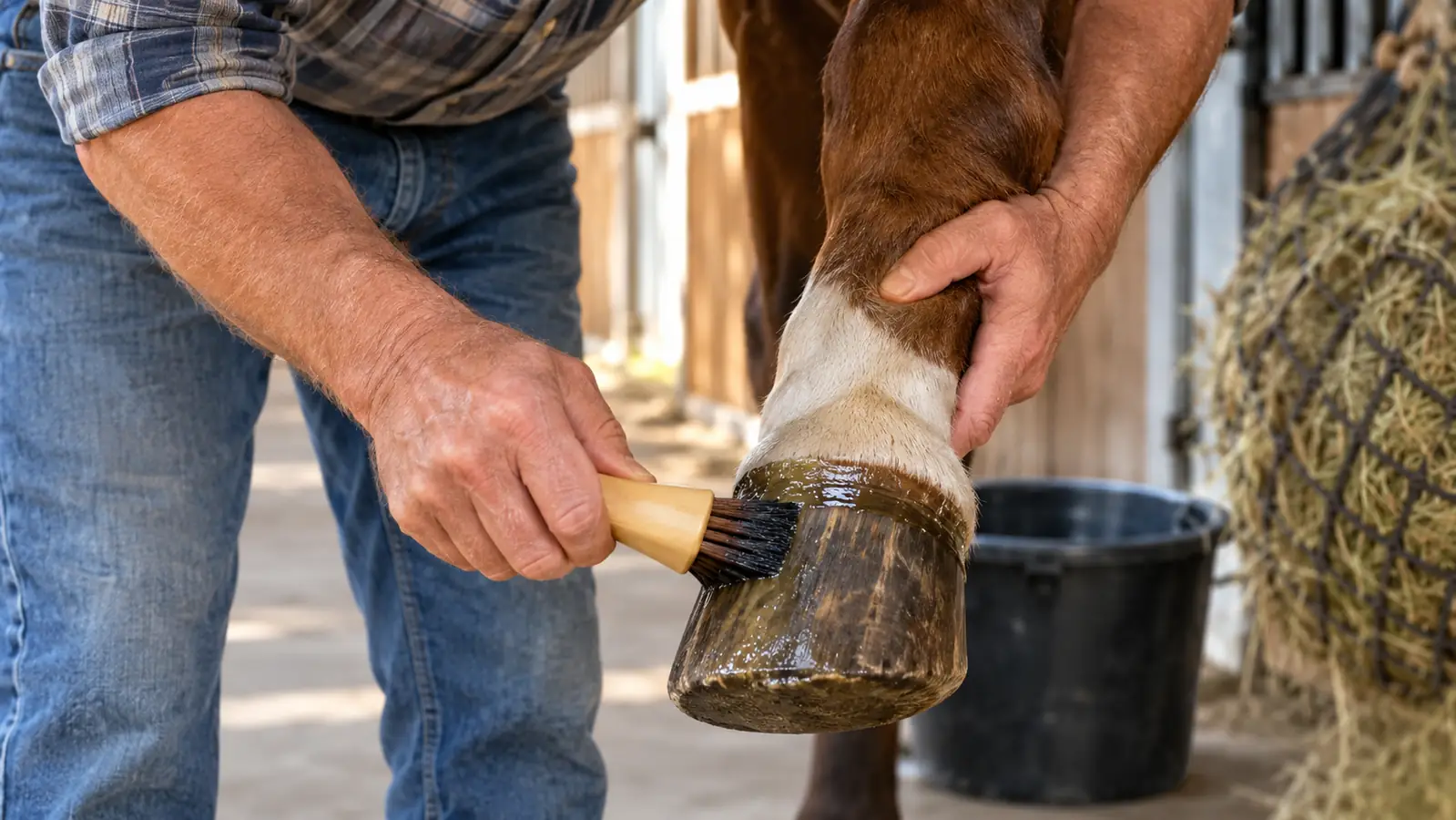
It is a liquid, not a paste and not a grease, with a pine scent that is strong when you first open it and fades within an hour of going on. The label lists avocado oil and glycerine along with what it calls essential nutrients. It is pine tar free, which matters more to me now than it used to. A tar dressing leaves a film over the wall, and a film over a dry wall keeps moisture out just as effectively as it keeps it in.
The claim on the listing is that it penetrates deep enough to stimulate collagen production at the coronary band, and that it attracts and retains moisture in the hoof, which helps prevent dryness, brittle cracks and splits. The moisture part I can see with my own eyes. The collagen part I cannot measure and I am not going to pretend otherwise. What I can tell you is that the coronary band is where new wall comes from, and keeping that band conditioned in desert heat seems like the sensible place to spend the effort.
It also claims to enhance hoof color. That is a real thing and I noticed it on Sahir, who is gray and gets shown a couple of times a summer. His hooves come up darker and more even after a few weeks of use, which sounds like a small thing until you are standing in front of a judge with a horse whose feet look unfinished.
What Changed, Month by Month
The first three weeks, nothing. I want to be clear about that, because I nearly quit. The hooves looked wet for an hour and then looked exactly as dry as before, and the wall picked up every bit of dust in the paddock. If you expect to see a difference in the first ten days you will be disappointed, and you will probably stop.
Around week five the chipping at Kasim's toes stopped. That was the first real change and it was the one I cared about most, because every chip is new wall lost. By the end of the second month the quarter crack on his left front had stopped running upward. It did not close. It stopped moving, which is what you want, and then it grew down with the wall the way a crack is supposed to.
The crack did not close. It stopped moving, which is what you want, and then it grew down with the wall.
At the four month mark my farrier, who comes every six weeks and has never once complimented a product I bought, asked what I had changed. The crack had grown out to within an inch of the ground and the wall on either side of it was tight instead of flared. He trimmed the last of it off in March. That was the end of a problem I had been managing for two years, and I had mostly accepted that I would manage it forever.
The last two months have been the boring, useful kind. The soles are less flaky. The white line on all three is tighter than it was in the fall. Nadia, who is thin skinned and gets small vertical splits at her heels every dry season, has had none this year. Nothing dramatic. Just less to deal with every time I pick up a foot.
One more thing about timing. The desert does not crack hooves in a straight line. Kasim was always worst in May and June, when the ground bakes and the flies arrive, and better in the winter while the irrigated pasture still has something green in it. So a month by month account is never clean. What I can say is that the improvement held through the hardest part of the year instead of fading, which is more than the oil I used before ever managed.
Where It Fell Short
It is tacky. For about an hour after application the wall will hold arena sand, shavings, and if you turn out in the dry lot, a fine coat of Arizona dust. I apply in the evening for that reason. If I put it on in the morning before turnout, Kasim's hooves come in looking like they have been breaded.
You have to clean the hoof first, and I mean properly. This is not something you can slap on over a dirty foot, because it seals what is under it. In the first month I got lazy twice with Nadia and both times her heels looked worse for a few days. I am fairly sure I trapped grit against soft tissue rather than doing anything useful.
The bottle is slick, there is no applicator in the box, and the pine smell will fill a closed tack room by the end of the week. None of those are reasons to leave it on the shelf. They are reasons to keep a rag and your own brush next to it.
If you board, understand that barn staff are not going to do this properly for you. It is a two minute job done right, but it is two minutes on each of four feet, and the person feeding twenty horses at night is not going to pick out every hoof and let it dry before applying. This is a job for the owner or nobody.
And the honest limit: eight months is not a full year of monsoon. The real test for hooves here is the wet and dry cycle in July and August, when the ground goes from baked to soaked and back again inside a week. This will be the first monsoon Kasim goes into with conditioned hooves instead of dry ones, and I will know more in September. What I can say now is that he has never come out of spring this sound.
What It Did for the Other Two Horses
Sahir is 14, in work five days a week, and most of that is on hard desert ground and gravel. His problem was never cracks, it was dullness and fine surface checking up the wall. Two applications a week have kept the checking from going anywhere, and he looks better in the ring, which is a shallow reason that I still care about.
Nadia is the one who surprised me. She is 9, thin skinned, and her heels split every summer. Conditioner on its own did not fix that. What fixed it was conditioner plus moving her off the dry lot at night and onto the irrigated pasture, so she was not standing in dust and heat for sixteen hours a day. The Farnam product helped the horn. The management change did the heavy lifting. I would rather tell you that than pretend a bottle did a job it cannot do alone.
What I Liked
- Stopped the chipping at Kasim's toes in about five weeks
- Grew out a two year quarter crack without it running further up the wall
- Tighter white line on all three horses after four months
- Pine tar free, so it conditions without sealing the wall under a film
- One 32 ounce bottle covered three horses for roughly ten weeks
Where It Falls Short
- Tacky for about an hour and it collects dust and shavings
- No applicator included and the bottle gets slick in your hand
- Strong pine smell in a closed tack room
- Worthless on a dirty hoof, so it adds a step to every application
- Will not fix a trim or a conformation problem, only the horn itself
Who This Is For
Buy it if you have a horse whose hooves chip, crack or split every dry season and you are willing to apply something three times a week for two months before you judge it. Buy it if your horse is barefoot and you want the wall and the coronary band conditioned rather than painted over. Buy it if your farrier has started mentioning flares and you want to hand him better horn to work with. On three horses at that schedule, one 32 ounce bottle ran me about ten weeks, so a single horse owner will get a long run out of one bottle.
It is also the right choice if you show, because it makes a hoof look finished without the kind of dressing shine that sweats off in the sun and leaves streaks on the trailer ramp.
The math on a barn with several horses is where it makes the most sense. One bottle, one brush, one tin, and a routine that takes ten minutes for three horses once they are used to it. Nadia now lifts a foot before I ask.
Who Should Skip It
Skip it if your horse has a lameness you have not had a vet look at. A conditioner does not touch abscesses, navicular pain, thin soles from metabolic trouble, or anything else happening inside the foot. Skip it if you cannot commit to the schedule, because two weeks of inconsistent use will tell you nothing at all.
Skip it if you want a once a week spray and forget product, if the tack room is small and closed and you cannot live with the pine smell, or if your horse is on deep wet bedding where a tacky hoof will just collect shavings all night. And skip it if the real problem is the trim. I got lucky that my farrier was already doing good work. A good conditioner on a bad trim is money spent at the wrong end of the problem.
Start now, before the dry season sets the wall
Three times a week to begin, twice a week to maintain, and give it two full months before you decide. Current price and the complete label are on Amazon.
Amazon Check Today's Price on Amazon →