
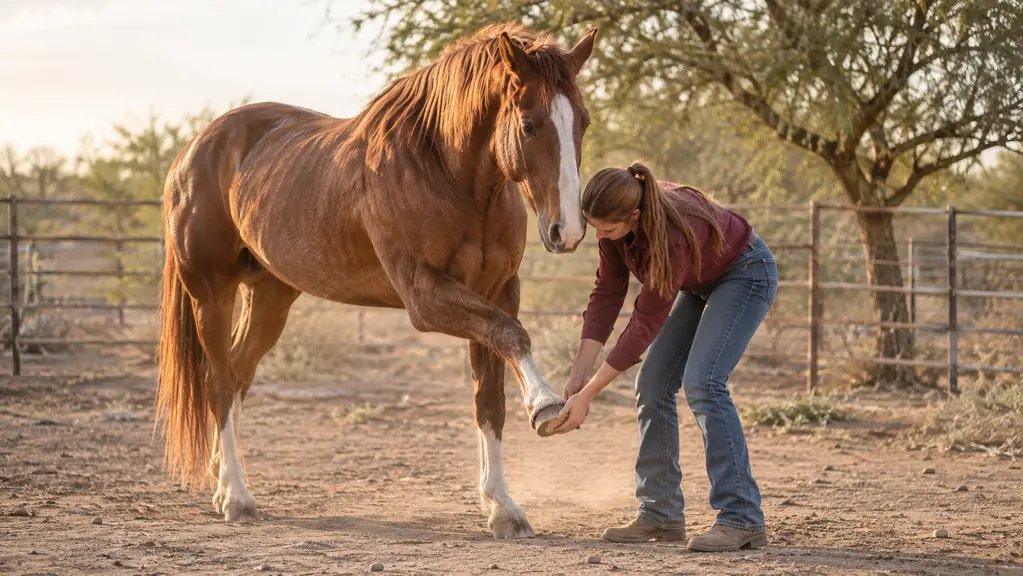
My farrier pulls in every six weeks, and the first thing he asks before he ever lifts a foot is how the old chestnut is doing. Not Sahir, the gray gelding I ride. Not Nadia, my bay mare. Kasim. Twenty-two years old, retired, and still the horse I worry about most.
Kasim has lived his whole life on hard desert ground. Caliche under a thin layer of sand, a dry-lot paddock, an irrigated pasture he mostly ignores. He does not wear shoes, and at his age I am not going to start. Every bit of concussion goes into a hoof wall that has spent twenty-two summers in Arizona heat with almost no humidity to soften it.
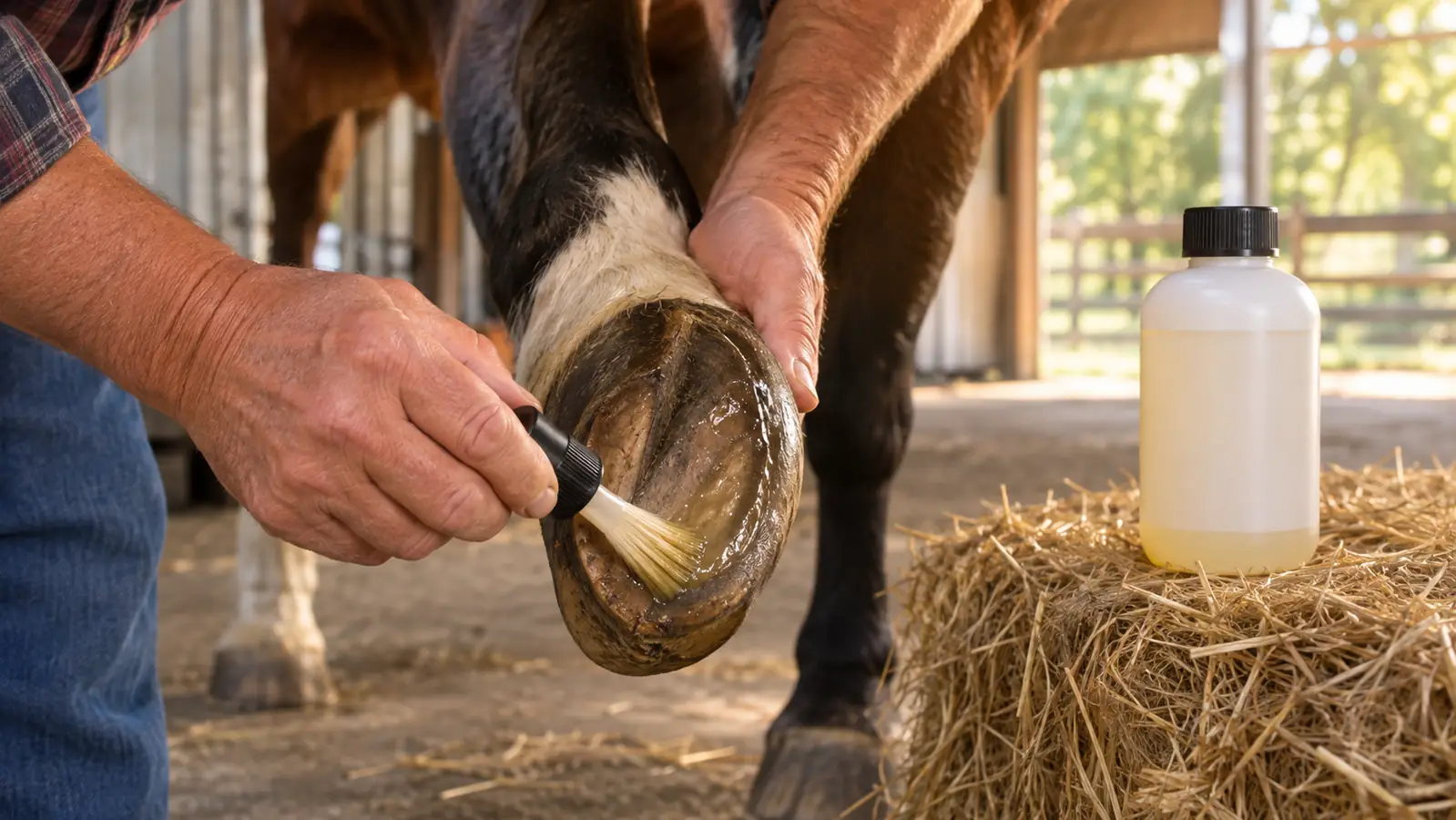
Three years ago a barn friend handed me a 32-ounce container of Farnam's deep-penetrating hoof conditioner and told me to stop overthinking it. That was the whole advice. She had used Farnam on a mare with shelly feet and did not have a lecture prepared. I took it home, put it on a shelf in the tack room, and forgot about it for a week.
Before that I had tried everything obvious. I picked his feet twice a day instead of once. I asked Danny to come at five weeks instead of six, which he did for a while and then told me, politely, that I was wasting his fuel. I moved Kasim onto the irrigated pasture overnight so his feet could sit in damp grass. He got fat and his feet chipped anyway. The problem was never how often I cleaned. It was that I was not putting anything back.
Here is what I do now. Three mornings a week, after I pick, I pour a little into my palm and work it into the hoof wall from the hairline down, then around the coronary band. It goes on as a liquid and soaks in rather than sitting on top of the hoof like a grease. It carries avocado oil and glycerine and pulls moisture into the hoof instead of sealing it out, and that matches what I see in the barn. Nothing about it is dramatic. It simply does not dry out.
Nadia gets it too, partly for her feet and partly because she will stand still for anything that involves being fussed over. Sahir gets a quick pass around the coronary band before a show, since it darkens the hoof and I am not above that.
The change was slow enough that I almost missed it. Hooves grow about a quarter inch a month, and I was looking at the bottom of a foot every single day, which is a bad way to see anything. Danny noticed it at the eight-week mark. No chips at the toe on either front. On Kasim that had not happened in years.
What convinced me to keep buying it was not the shine. It was where the new growth came in. Farnam formulates this to penetrate down to the coronary band, which is where the hoof wall is actually produced. Conditioning the outside of a wall is one thing. Feeding the band that grows it is another. After two farrier cycles Kasim's new wall came down tight and even instead of flaring at the toe.
No chips at the toe on either front. On Kasim that had not happened in years.
The Step Between Farrier Visits
Farnam's deep-penetrating hoof conditioner works into the wall and the coronary band instead of sitting on top of it. It is what three Arabians on hard desert ground get three mornings a week.
Amazon Check Today's Price on Amazon →
I want to be clear about the limits, because a hoof conditioner is not a farrier and it is not a feed supplement. If your horse has an abscess, a seedy toe, or a wall that is already separating, this is not the thing that fixes it. Call your farrier and your vet. What it does is hold the line between visits so the wall stays pliable enough not to crack in the first place.
Late summer is the real test. The monsoon rolls in, the wind picks up, and everything on this place wears a fine coat of dust, including the inside of the tack room if I leave the door open. I keep the container on a shelf and wipe the rim before I open it. The pine smell is strong for the first few days and after that you stop noticing it. It is pine tar free, which matters to me, because the tar-based products I used years ago collected dirt and turned a hoof into a mess.
One 32-ounce container lasted most of a summer with three horses, using it three times a week on Kasim and once or twice a week on the other two. I am not careful with it and I still did not run out before the weather broke.
I have used it on a horse that was not mine. A boarder's mare came in with dry, brittle feet after a year on sand, and four weeks of the same routine made a visible difference at the nail holes. That is not a controlled study. It is one mare and one summer. But it is more evidence than I had before.
Danny noticed before I told him. He was under Kasim, picked up the near hind, and said the wall felt different. Then he asked what I had changed. I told him. He shrugged and said he has seen worse things put on a hoof. From a man who charges by the horse, that is a rave review.
What I'd Tell You If We Were Sitting at My Kitchen Table
I would tell you not to buy a shelf of products. Pick your horse's feet every day, keep your farrier on a schedule you will actually hold, and then put one thing back into the hoof on the days in between. For me that one thing is Farnam. If your horse is young, sound, and living on soft ground, you may not need anything at all. If you have a 22-year-old chestnut on caliche outside Scottsdale, you do.
Start With One Container, Not a Shelf Full
Daily picking and a farrier you trust come first. Farnam's hoof conditioner is what goes on between visits. One 32-ounce container carried me through a summer with three horses.
Amazon Check Today's Price on Amazon →