
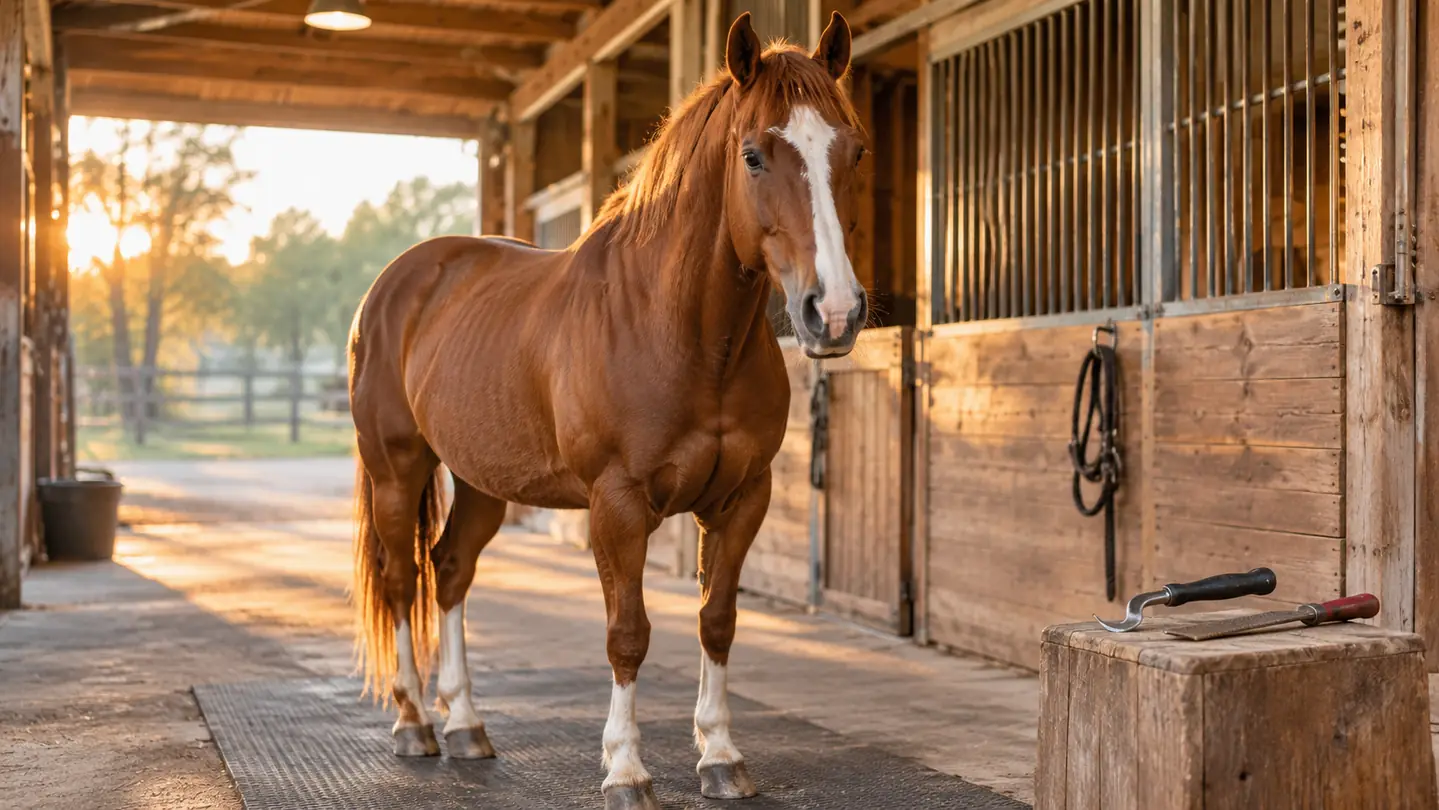
Kasim has been barefoot since I retired him six years ago, and every June his hoof wall tells me exactly how dry the ground has gotten. He is 22, chestnut, and the least sound of my three Arabians, so his feet get more of my attention than the other two combined. I have run Farnam Horseshoer's Secret on him for three summers now. I have used Absorbine Hooflex, both the liquid and the ointment, for a lot longer than that, mostly on horses that were shod. Short answer: for a barefoot desert horse with a chipping toe, Horseshoer's Secret is what I buy, and Hooflex is what stays in the trailer.
That is not a knock on Hooflex. It has been in every tack room I have ever walked into, and it earned the shelf space. But when I am standing at the wash rack in July with a barefoot retiree whose toe is starting to split, the decision comes down to three things: how fast the liquid goes in, how long the hoof holds onto what it took in, and how far a bottle goes. Horseshoer's Secret wins all three for me. What Hooflex wins is texture and smell, and on a shod horse in a busy barn those are not small things. The Farnam bottle sits at 4.8 stars across 1,488 ratings, which is close to what I have seen in my own barn.
| Farnam Horseshoer's Secret | Absorbine Hooflex | |
|---|---|---|
| Form | Liquid, 32 ounces, poured into a cup and brushed on | Sold as a liquid and as a thicker ointment |
| Cost per ounce | Lower cost per ounce in the 32-ounce size | Higher cost per ounce, highest in the ointment |
| Speed of absorption | Dry to the touch within a couple of minutes | Sits on the surface longer, especially the ointment |
| Change at the coronary band | New growth came down flat by week three on Kasim | Softer wall and better shine, less change at the hairline |
| Twice-weekly schedule | Held six weeks at two applications a week, even through monsoon dust | Needed three applications a week to feel comparable |
| Application on a shod horse | Thin liquid runs past the nail holes and down onto the sole | Ointment stays packed against the wall where you put it |
| Smell | Pine, and it carries in a closed barn | Milder in the aisle, easier on a fussy horse |
| Best for | Barefoot retirees and dry-climate hoof walls | Shod horses and barns that want two textures from one brand |
Why an Arabian in the Desert Is a Hard Case for Any Conditioner
Arabians are not fragile, but they are fine-boned and thin-skinned, and the ones I have owned carry less hoof under them than the stock horses I rode as a kid. Less wall means less margin for error when the ground is baked. Add the desert and the arithmetic gets worse. We run single-digit humidity for weeks at a stretch, the dry lots are hardpan, and the hoof wall is basically a sponge nobody is refilling. The irrigated pasture is the only soft ground my horses stand on, and Kasim is out there maybe four hours a day at best.
Then there is the shoe question. I do not shoe Kasim. My farrier and I made that call when he retired and the riding stopped, and I stand by it, but barefoot in dry ground means the wall wears down and dries out at the same time, with no shoe and pad holding anything in. That is the exact situation where a thin penetrating liquid earns its keep over a dressing that sits on the surface. On a shod horse in a mild climate I would answer this differently, and I want to be honest about that before I start handing out verdicts.
How I Set This Comparison Up
My place is twelve acres outside Scottsdale, with a four-stall shed-row barn, a wash rack, two dry-lot paddocks and one irrigated pasture. That mix is hard on hooves. The dry lots are baked and dusty, the pasture is the only soft ground they get, and from May through September the whole property is essentially an oven with a breeze. My farrier comes every six weeks. He does not shoe Kasim. He trims him and says some version of the same thing every visit: keep the wall conditioned and the toe will stop running forward. I have heard that sentence enough times to finally take it seriously.
I ran this comparison across six weeks in late spring and early summer, which is the window when Kasim's feet go from fine to not fine. Farnam Horseshoer's Secret went on Kasim. Absorbine Hooflex went on Nadia, my 9-year-old bay mare, so that I had both products in my hands on the same days and in the same heat. Nadia has good feet and thin skin, which made her a fair test of texture and of how a product behaves around a mare who does not suffer rough handling. Sahir, my 14-year-old gray gelding, got nothing but a pick and a brush. He was my control.
I want to be straight about what this is. I did not measure hoof wall thickness with calipers, I did not send samples anywhere, and six weeks at one barn in one climate is not a trial. What I can tell you is what changed under my hand, on horses I have owned for years, in heat that will crack a hoof if you look at it wrong.
Where Farnam Horseshoer's Secret Wins
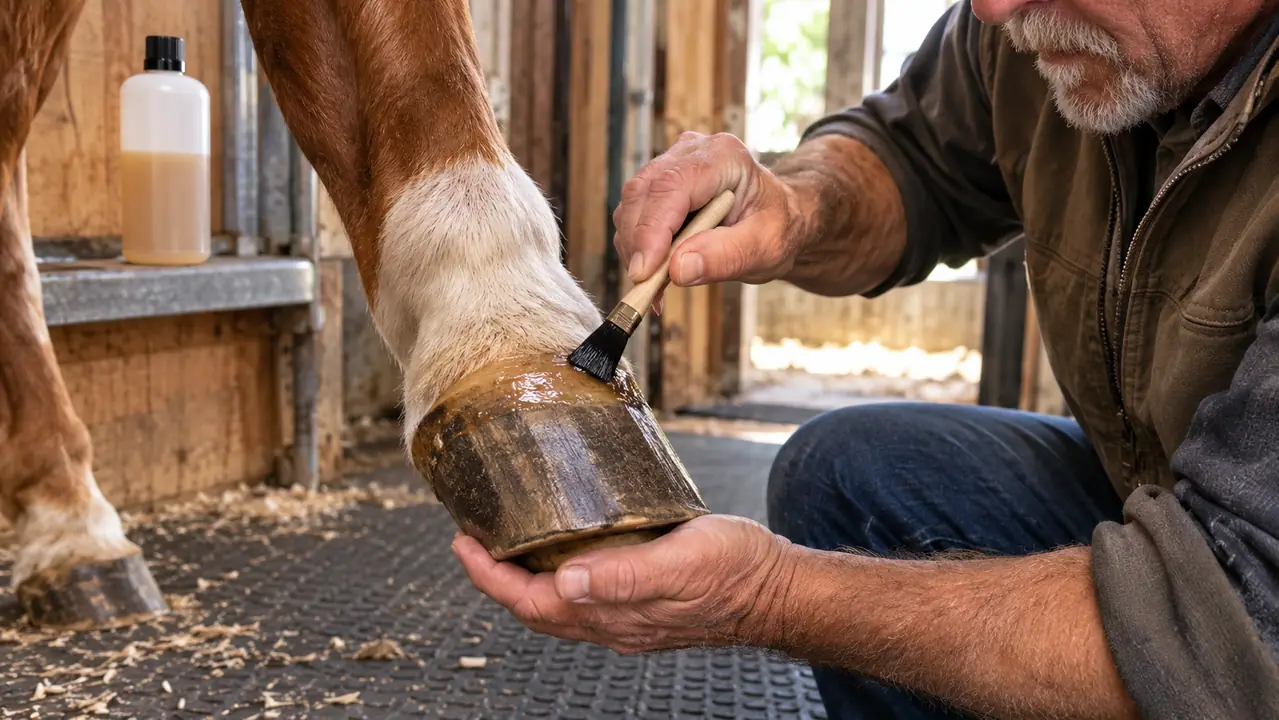
The first thing you notice is speed. The Farnam product is a thin liquid, so it goes into the hoof instead of sitting on top of it. I brush it on the wall, around the coronary band and across the sole, and by the time I have done the fourth hoof the first one is dry to the touch. The listing credits it with penetrating down to the coronary band to support collagen production there, and it names avocado oil and glycerine among the ingredients. I cannot see collagen from the outside. I can tell you that by the third week the new growth coming down from Kasim's hairline was tight and flat instead of flaring out to the side the way it had been in April.
The second thing is moisture. The listing says it attracts and retains moisture in the hoof, and that matches what my hands found. Kasim's wall had been brittle enough that my hoof pick would raise a chip if I got careless. By week four I could press a thumb into the wall above the toe and get a little give back. The third thing is mileage. A 32-ounce bottle gets me through most of a summer at twice a week on one horse, and at 1.9 pounds and roughly 7.75 inches tall it lives on the shelf in my tack room without tipping over every time I reach past it. I am not rationing it, and that counts for something when the alternative is applying three times as often to get the same result.
Where Absorbine Hooflex Wins
Texture, plainly. The ointment stays where you put it. On a shod horse, where I want product sitting against the wall and holding there rather than running down across the sole, that is the behavior I want. I also like having the choice between a liquid and an ointment from the same brand, because a barn with horses in work and one retired gelding does not need a single answer for all of them. If your farrier wants something packed along the wall while a crack grows out, the ointment does that job and a thin liquid does not.
Smell and temperament. Hooflex is milder in the aisle. Horseshoer's Secret is pine, and pine is not subtle. In a closed barn in August with no breeze moving, that smell stays with you, and it stays on your hands through the evening feed. Nadia, who is fussy about anything near her shoulder, stood noticeably better for the Hooflex routine than she does for the Farnam one, and I think the smell has more to do with that than the feel does. If you have a horse that objects, that is a real point in the Hooflex column and I am not going to pretend otherwise.
If your barefoot horse chips at the toe every June, this is the bottle I reach for
The 32-ounce Farnam bottle that took Kasim from a splitting toe to flat new growth in six weeks, at two applications a week.
Amazon Check Today's Price on Amazon →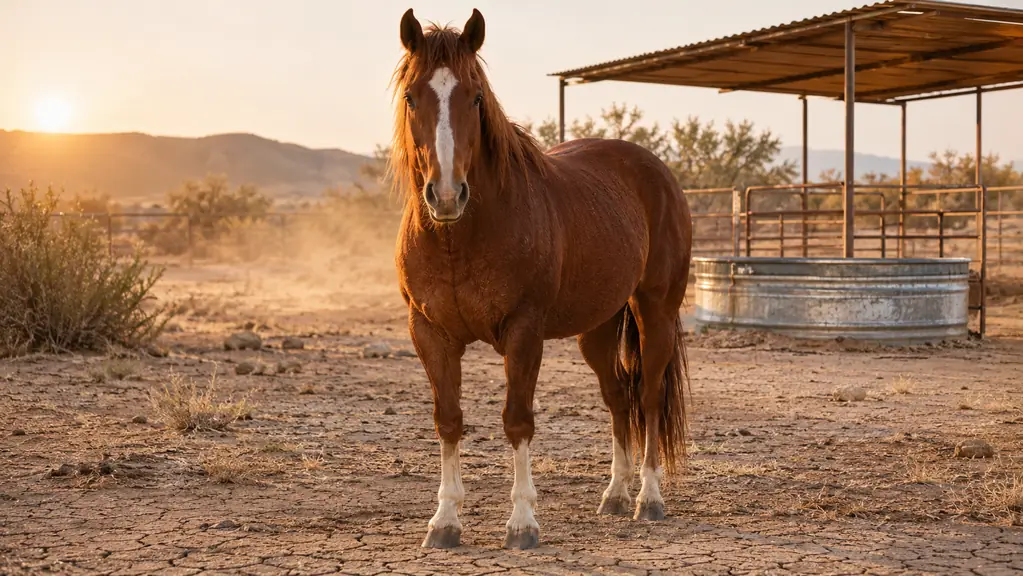
Six Weeks on Kasim, and What My Farrier Said
Weeks one and two were unremarkable, which is what I expected. I applied twice a week after the evening feed, once the horses were in and the flies had thinned out. The split at his left toe did not get worse and it did not get better. His sole stayed chalky and dry and I spent two weeks wondering whether I was wasting my time and a shelf's worth of patience.
Weeks three and four were when it turned. The wall coming down from the coronary band was coming down flat instead of angled out. The split stopped traveling. The sole at the toe lost that chalky look and went back to something closer to leather, and the whole hoof stopped sounding hollow when I picked it.
By week four the split at his left toe had stopped traveling, and the new wall coming down from the hairline was flat instead of flared. My farrier noticed before I said a word.
By the end of six weeks my farrier spotted it before I mentioned anything, which is the only test I actually trust. He picked up the left front, looked at the hairline, and asked what I had changed. That is a man who has trimmed this horse for nine years and does not hand out compliments. He also told me the thing I already half knew, which is that a conditioner supports a good trim and cannot replace one. If your farrier is leaving a long toe and a stretched white line, no bottle fixes that.
The Application Routine That Made the Difference
Technique mattered as much as product. I pick and brush the hoof out first, dry, with a wire brush and a pick, because conditioner painted over packed dirt is money in the dirt. Then a thin coat on the wall, the coronary band and the sole, using an old hoof brush I keep in a plastic cup. I do not pour it on. Twice a week through the hot months, once a week from November through February, and always the day after the farrier leaves, since that is when the hoof is most open to taking something in.
What I skip: I do not apply it right before a ride in sand, because everything sticks to it, and I do not apply it to a hoof that is still caked and wet, because all that does is seal the mess in against the wall. Kasim lives in a dry lot, so mud is not the problem it would be somewhere green. If you are in a place with real mud, wait for the hoof to dry out, then apply, then keep the horse off wet ground for an hour if you can.
Who Should Buy Which
Buy Horseshoer's Secret if you have a barefoot horse in a dry climate, a retiree with a chipping toe, or a horse whose new growth keeps flaring out instead of coming down tight. Buy it if you want one bottle that carries a whole summer at twice a week and you can live with a strong pine smell on your hands. It is the bottle I reach for on Kasim, and Kasim is the reason I started paying attention to hooves in the first place.
Buy Hooflex if your horses are shod, if you want an ointment that stays where you put it, or if you have a horse that will not stand for a thin liquid and a smell in its space. It is also the better pick for a barn where different horses need different textures from one brand. Neither product is a cure for a bad trim, a thin sole or a horse that genuinely needs shoes. They are conditioners. They do what a conditioner can do, which is more than nothing and less than a farrier.
The 32-ounce bottle that gets my barefoot gelding through a Sonoran summer
Two applications a week, six weeks, one flat new hairline. If your horse dries out every June like mine does, start with the bottle that actually goes into the hoof.
Amazon Check Today's Price on Amazon →