
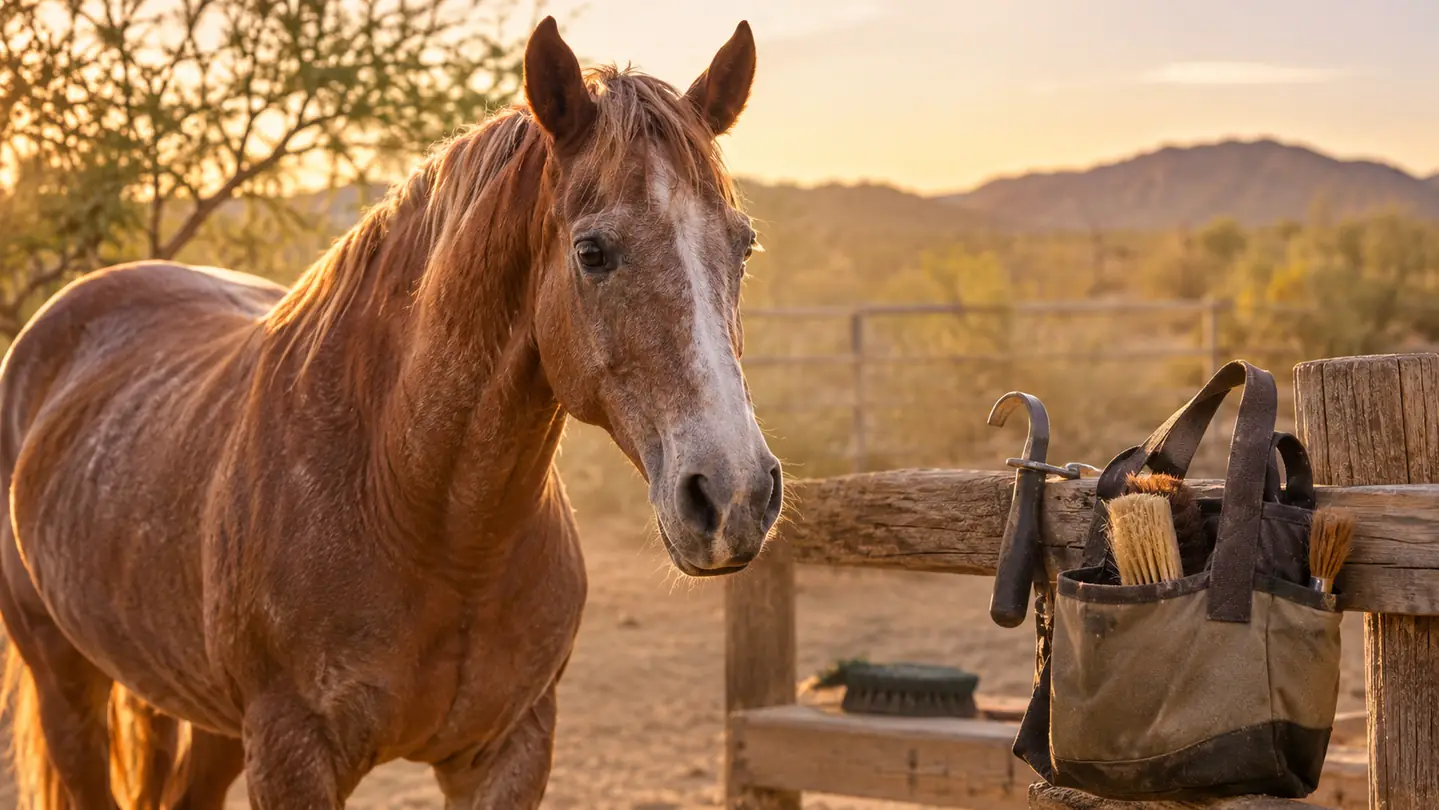
The first thing I noticed about Farnam Horseshoer's Secret was not the pine smell. It was how quickly the liquid disappeared into the hoof wall on Kasim, my 22-year-old chestnut Arabian gelding. Kasim is retired now, and his hooves have the dry, chalky look that desert summers seem to pull out of an older horse. I keep three Arabians on my place outside Scottsdale, and I do my own hoof picking between farrier visits every six weeks. I picked up the 32-ounce container because I wanted a conditioner I could use on all three, not a show-day cosmetic. This is the honest review I wish I had read first, including the parts that are less convenient than the label suggests.
Farnam is not a new name in my barn. I have used enough hoof products over 25 years to be suspicious of anything that promises a quick fix. What made me try this one was the ingredient list and the way it is meant to work: avocado oil and glycerine, a liquid that penetrates, and a claim about supporting collagen at the coronary band. That is a more specific story than most hoof dressings tell. It is also not a cure for a horse that needs the farrier, and I will get to that. First, the short answer.
The Quick Verdict
A serious conditioner for dry hoof walls, with useful ingredients and a pine scent that asks for a little planning. It is not a treatment for cracks or lameness.
Amazon Check Today's Price →For dry hoof walls, not for deep cracks
If your horse has chalky, dry hooves and you already have a farrier schedule, this is the Farnam product I would start with. Check the listing for the current size and details.
Amazon See Farnam Horseshoer's Secret on Amazon →What Nobody Tells You Before You Buy It
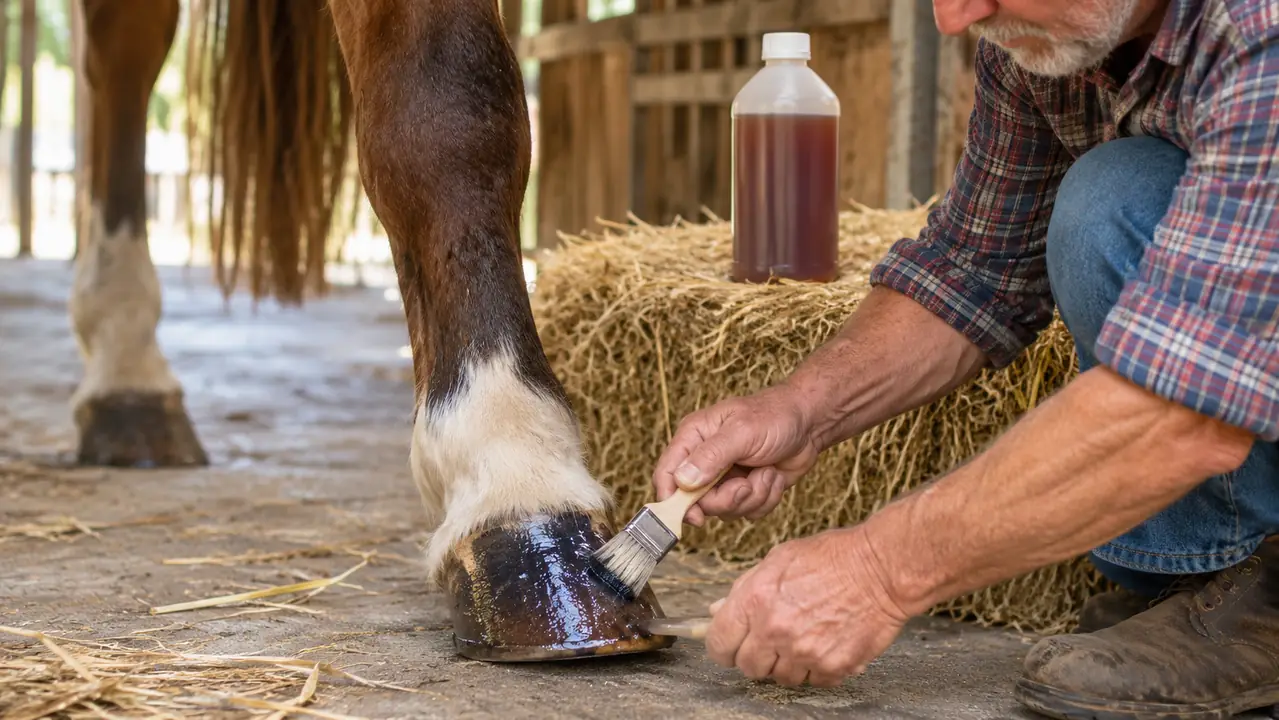
The first surprise is the format. This is a liquid, not a cream or a paste, and it arrives in a 32-ounce container that weighs about 1.9 pounds and measures 4.25 by 4.25 by 7.75 inches. That is a useful size for a three-horse barn, but it is not a pocket-sized bottle you can tuck into a grooming bag without thinking about it. The included components list only the conditioner, so you need your own rag, sponge, or hoof brush for application. I use a small cotton rag and a shallow cup. If you turn the container upside down and pour straight onto the hoof, you will waste more than you need and you will drip on the barn aisle.
The second surprise is the pine scent. It is real, and it is strongest when the container is open. The product is pine tar free, which matters if you have avoided old-fashioned tar dressings because of the mess or the smell, but pine tar free does not mean fragrance free. I keep the lid tight and store it on the bottom shelf of my tack room. The listing also says yam free. I do not have a horse with a known yam sensitivity, so I cannot speak to that from experience. I can tell you that none of my three Arabians reacted to the conditioner on their hoof walls.
One more practical note: a 32-ounce container is more than one horse needs in a month. If you only have one horse, you will be using this bottle for a long time, and that is fine as long as you store it properly. I keep mine out of direct sun and with the lid tight. The liquid has not separated or changed texture in my tack room. I would not leave it in a hot trailer all summer, but I would not leave any hoof product there. The size is a plus for a small barn and a slight question mark for a one-horse owner.
How I've Used It on My Own Horses
I started with Kasim because his hooves are the driest of the three. He is 22, retired, and not shod. My farrier comes every six weeks, and between those visits I pick his feet daily and apply this conditioner three evenings a week. I work a small amount into the hoof wall and around the coronary band with a rag. I do not pour it into the sole or pack it into the frog. The label talks about penetration and moisture, so I want the wall and the hairline to get the product, not the bottom of the foot where dirt collects.
Nadia, my 9-year-old bay mare, has tighter, harder hooves. She does not need the same schedule. I use it on her once a week, mostly on the outside wall and around the coronary band, and I skip it if the barn is dusty and I know she is going out on the dry lot. Sahir, my 14-year-old gray gelding, gets a light application before a regional show because the conditioner improves hoof color and makes the hooves look finished without a greasy shine. I do not use it on all three every day. That would be more product than they need and more time than I have.
I patch tested it before I used it on all three. I put a small amount on a rag and rubbed it on a lower hoof wall on Nadia, because she is the sensitive one. I waited a day and looked for any reaction. There was none. I would do that with any new product, especially on a thin-skinned mare. After that I felt comfortable using it on Kasim and Sahir. I still keep it away from any open cut or irritated skin around the coronet. A hoof conditioner is not a wound ointment, and I do not treat it like one.
The first two weeks were not dramatic. The hoof walls looked slightly less chalky, and the surface held a little more sheen after it dried. The real change came after a full trim cycle. My farrier did not have to spend as much time on the dry, ragged edges, and Kasim had fewer small chips along the wall. I am not going to tell you his feet looked brand new. He is an older horse with older feet. But the hoof wall was more pliable and less brittle, which is exactly what I wanted from a conditioner.
What It Does Well
The biggest strength is how fast the liquid goes in. Some hoof dressings sit on the surface and collect dust. This one penetrates quickly, and within a few minutes the wall looks less thirsty. The listing says it attracts and retains moisture, and that matches what I saw in our dry heat. Scottsdale summers can pull moisture out of a hoof faster than any conditioner can put it back, so I am not expecting a transformation. I am looking for a product that helps the hoof hold what moisture it has. This one does that better than the oil-based dressings I used years ago.
The ingredient story is also more substantial than most. Avocado oil and glycerine are the two I can point to on the label, and the product is meant to stimulate collagen production at the coronary band. I am not a veterinarian, and I cannot measure collagen in my barn. What I can tell you is that the new hoof growth coming down from the coronary band looked smoother and stronger after several weeks of use. That is the area I care about most, because the wall I see at the bottom is already old growth. If the new growth is better, the hoof is better.
It also does the cosmetic job well. The listing says it enhances hoof color, and it does. Kasim's hooves looked darker and more even, which made him look tidier for the farrier and for the show ring. I like that it does not leave a sticky residue that picks up arena sand. It dries down enough that I can turn a horse out after ten or fifteen minutes, which matters when I am fitting grooming around an Arizona afternoon.
The other thing I appreciate is that I can use it on all three horses without changing my whole grooming routine. I pick, I clean, I apply, I let it dry, and I turn out. It adds maybe ten minutes to an evening if I am doing one horse, and closer to twenty if I am doing two. That is not nothing, but it is manageable. I have used products that required wrapping, soaking, or a long drying time. This one fits into the routine I already have, which is the only reason I have stuck with it.
The test for me was not whether Kasim's hooves looked glossy on show day. It was whether they stopped chalking up between farrier visits in July.
Where It Falls Short
This is a conditioner, not a treatment. If your horse has a deep crack, an abscess, laminitis, or unexplained lameness, do not buy a bottle and hope. Call your farrier and your vet. I have seen people use a hoof dressing to cover a problem that needed a radiograph and a proper trim. That is not fair to the horse. This product can support good hoof care, but it cannot replace it. The listing warranty is a satisfaction guarantee or money back, and that is fine, but no refund fixes a hoof that needed professional attention.
The application is fussier than a paste. Because it is a liquid, it can run down the hoof and onto your hand. I learned to pour a small amount into a cup first and dip the rag, rather than tipping the 32-ounce container over a horse's foot. If you are grooming in a hurry, this is not the product you reach for. It also takes consistency. Three evenings a week for Kasim is a real commitment in show season, and if I skip two weeks I can see the difference in the hoof wall. A product that needs a routine is not a bad product, but it is not a shortcut.
The results are gradual. I saw a surface change in about ten days, but the wall quality took a full trim cycle to show. If you want a hoof to look better for one show, you can get that. If you want a stronger hoof, you need to think in months, not days. The pine scent is another small drawback. I do not mind it, but my tack room is small and the smell lingers when the lid is off. If strong smells bother you, decant what you need outside and keep the main container closed.
I also wish the container had a narrower pour spout. It does not, so a cup is my workaround. That is a small complaint, but it is the kind of thing you notice every time you use the product. The 4.25 by 4.25 by 7.75 inch container is stable on a shelf, and the 1.9 pound weight is not hard to handle, but it is still a full-size container, not a grooming bag bottle. If you board your horse and haul your supplies back and forth, decant what you need for the week and leave the rest at home.
What I Liked
- Penetrates quickly into dry hoof walls instead of sitting on the surface
- Contains avocado oil and glycerine, with a specific claim about collagen support at the coronary band
- Pine tar free for owners who avoid traditional tar dressings
- 32-ounce container is practical for a small barn with several horses
- Improves hoof color and gives a finished look without a greasy shine
- Satisfaction guarantee or money back per the listing
Where It Falls Short
- Liquid application is messier and slower than a paste
- Pine scent is strong when the container is open
- No applicator is included, so you need your own rag or brush
- Results take weeks and depend on a consistent routine
- Not a treatment for deep cracks, abscess, laminitis, or lameness
- Full-size container is awkward for a grooming bag
The Pine Scent and the Pine Tar Confusion
People see pine on a hoof product and assume pine tar. This one is pine tar free, and the scent is closer to pine oil than to the black, sticky tar dressings some of us grew up with. That distinction matters. Pine tar has its place in some hoof care routines, but it can be messy and some owners avoid it. This conditioner gives you a pine scent without the tar. I still would not call it fragrance free. If you are sensitive to smell, open it outside the first time.
The yam free note on the listing is another detail I noticed. I do not have a horse with a yam allergy, so I cannot tell you if that matters for your barn. I can tell you that the product is a liquid for equine hooves, and the label is clear about its intended use. I would rather see a specific note like that than a vague claim. It tells me the company is thinking about owners who have to read every label. That is not a reason to buy it by itself, but it is a small point in its favor.
Who This Is For
This is for the owner who has a horse with dry, chalky, brittle hoof walls and already has a farrier schedule. It suits a retired horse like Kasim, a thin-skinned mare like Nadia, and a show horse like Sahir, as long as you are willing to apply it consistently. It is also a good fit for a small barn with three or four horses, because the 32-ounce container is enough to use on more than one animal without running out in a month. If you want a product that supports moisture retention and hoof color without pine tar, Farnam's deep-penetrating conditioner is a sensible place to start.
Who Should Skip It
Skip it if you want a one-time fix for a hoof that is already cracked through. Skip it if your horse is lame, has an abscess, or has active laminitis, and call your vet instead. Skip it if you know strong pine scents give you a headache, because this one is not shy. Skip it if you are not going to use it on a schedule. And skip it if you need an applicator in the box, because the included components list only the conditioner. None of those are reasons to call it a bad product. They are reasons to be honest about what it is.
What I'd Do Differently
If I were starting over, I would begin in early spring, before the worst heat, instead of waiting for the first dry August. I would also take a photo of each hoof before the first application, because the change is gradual and easy to forget. I would decant a small amount into a cup before I bring the horse out, so I am not fumbling with the 32-ounce container while Kasim stands on three legs. And I would keep the main container closed and on a low shelf, because the pine scent is stronger than I expected and the liquid can tip if it is stored on a high nail.
If dry hoof walls are the problem, start with a routine, not a promise
Farnam Horseshoer's Secret is the conditioner I keep in the tack room for Kasim and the other two. It is not a cure, but it is a useful tool when used between farrier visits.
Amazon Check Farnam Horseshoer's Secret on Amazon →