
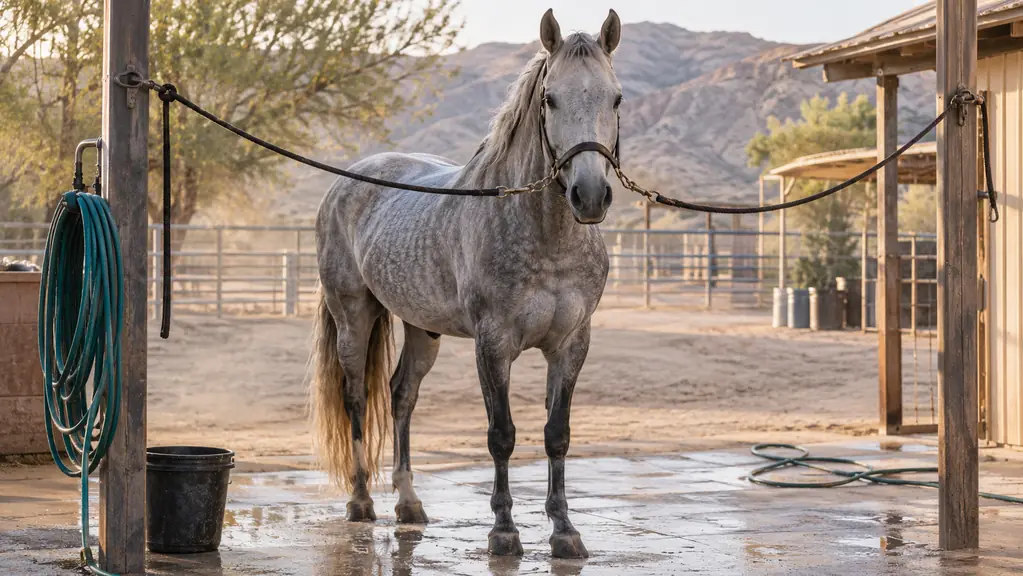
An Arabian tail can go from sleek to hopeless in a single dusty afternoon. You pull the saddle, you look behind you, and the last six inches have tightened into a knot the size of your fist. Pull at it with your fingers and the horse flinches. Attack it with a brush and half the hair stays in the bristles. I keep three Arabians on twelve acres outside Scottsdale, and I have made every mistake in this article at least twice, so let me save you the four years it took me to stop making them.
What I use now is Absorbine ShowSheen, the 32 ounce quart spray. It is a detangler and a hair polish in one bottle, unscented, and it works by coating each strand instead of soaking the hair in oil. The listing says it cuts breakage by 40 percent. What I can tell you is that my comb comes back with less hair in it, which is the same thing measured with a cheaper instrument. It carries silk proteins and pro-vitamins, and it is labeled for horses, dogs, cattle and a long list of other animals, which tells you something about how mild the formula is meant to be.
One quart, unscented, and it lives on my wash rack
32 ounces does a full show season across three horses at my house. Coats each strand, carries silk proteins and pro-vitamins, and works on the dogs after a muddy trail ride too.
Amazon Check Today's Price on Amazon →Why Arabian Manes and Tails Knot Differently
Arabians have fine hair and thin skin, and both facts work against you. The hair is soft enough that it mats instead of sliding apart, and the skin underneath is thin enough that a yank on a knot reads as a sharp pain rather than a tug. Nadia, my nine year old bay mare, will tolerate almost anything except a comb dragged through a dry knot. She tells you about it with her whole body, and she remembers who did it.
Then there is the desert. Dust works into the hair like powder into a wool sweater, and late summer adds enough static to make a tail stand out from the hocks. A tail that drags in the dirt collects seed heads and burrs, and once those are woven in, no amount of brushing gets them out without breaking hair. Last August a monsoon came through and dropped a section of the east fence line into the paddock. Two days later I haltered Sahir and his tail looked like it had been used to sweep the arena. It took me forty minutes with my fingers and a spray bottle to get back to hair I could actually comb, and I lost maybe a pinch. The old me would have reached for the brush, and the old me would have thrown away four inches. That is why I treat detangling as a routine and not a rescue. Twenty minutes twice a week beats two hours of tugging the night before a show.
Step 1: Start With Hair That Is Actually Clean
ShowSheen works best on clean hair. On dirty hair it seals the dust in place and gives you a slippery knot instead of a loose one, which is worse than where you started. So the first step in my barn is a wash, and it happens before the comb comes out of the tote. A dirty tail is also harder to read. You cannot tell a burr from a mat when everything is the same shade of dust.
Use a mild horse shampoo and more water than feels reasonable. Scrub the dock, the base of the tail where the skin is thickest, with your fingertips and not your nails. Work down the tail in sections instead of balling the whole thing up and scrubbing it like a dishcloth. Rinse until the water runs clear, because shampoo residue leaves hair tacky and tacky hair knots faster than clean hair ever does. I wash with cool water straight from the hose, never warm water from the house. Warm water opens the hair shaft and leaves it feeling rougher once it dries, and out here in June the hose is already warm enough by ten in the morning. The first year I owned Kasim I washed him with dish soap because that was what happened to be in the barn. It stripped his mane down to straw, and it took two months of conditioning to get anything back.
The mane gets the same treatment, only gentler. I wash in three passes and rinse between each one. For Kasim, my 22 year old chestnut gelding who is retired now, I skip the mane wash entirely in winter. He gets a spot clean and a light spray, and that holds him until spring. Older horses lose condition in the hair first, and a harsh wash strips what little oil they have left.
Step 2: Spray From the Ends Up, Not the Top Down
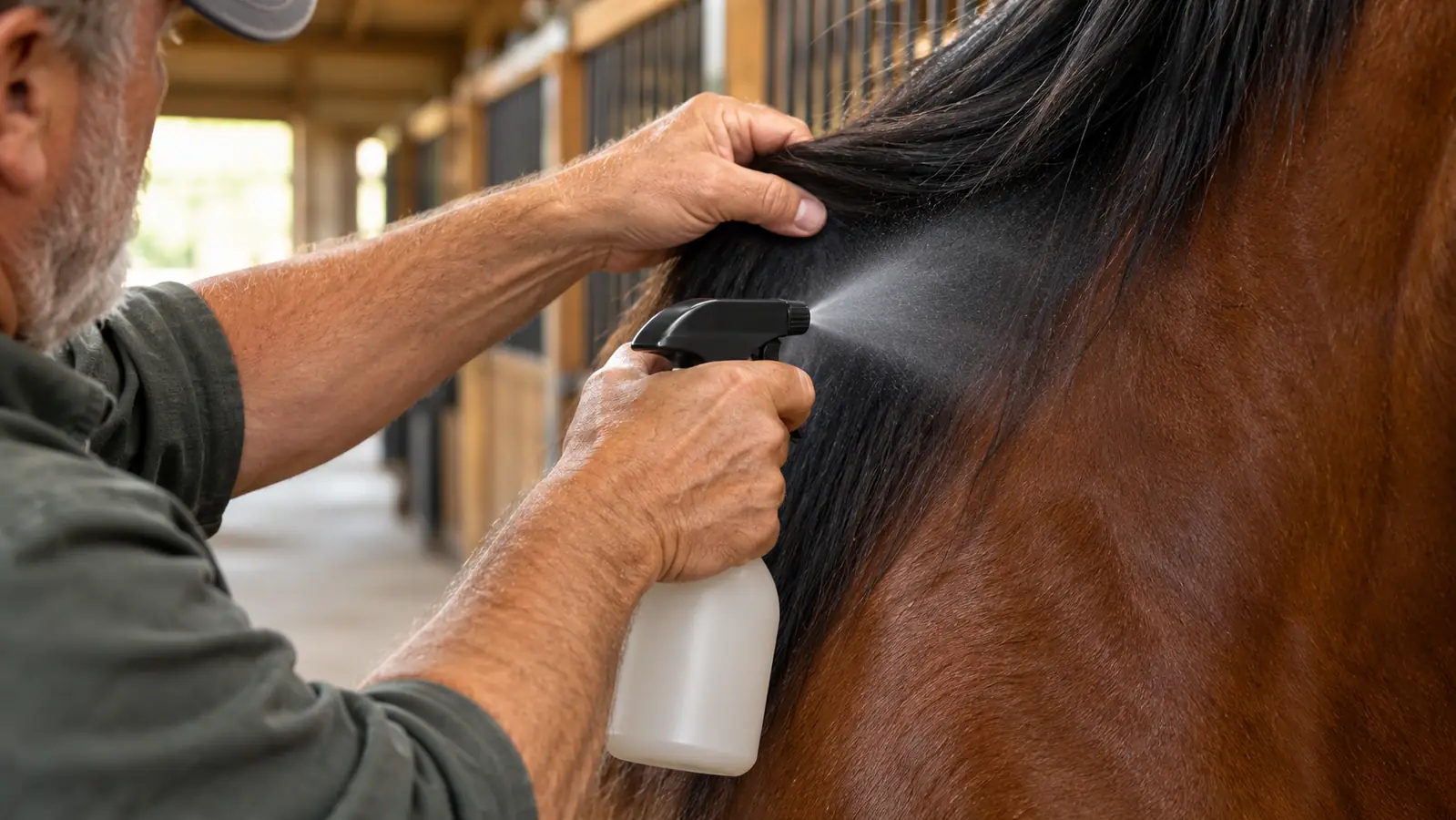
Most people spray the top of the tail and comb downward, which drives every knot into a tighter knot at the bottom. Work the other direction. Hold the bottle a hand's width from the hair and mist the last four inches of the tail. Wait about thirty seconds. Then mist the next section up. You are walking toward the dock one section at a time, and you are letting the product loosen the strands before anything pulls on them.
The spray bottle puts out a fine mist rather than a stream, and that matters. A soaked tail is heavy, drippy and no easier to comb. Three or four pumps per section is my rule. If the hair still squeaks when you run your fingers through it, add one more pump and give it a moment. For years I was a top-down sprayer. I would soak the entire tail, wait, then start at the dock and pull downward with a wide tooth comb, and I could never work out why the bottom kept tightening back up. The spray was doing its job. The direction was not. Once I flipped it and started at the ends, the same bottle on the same tail stopped fighting me.
Sahir, my 14 year old gray gelding, has a tail that grows thick at the dock and thin at the bottom, so his sections are small and his spray is light. A fine tail with a heavy hand just gets greasy. This is also the step where I stop judging by look and start judging by feel. If my fingers glide through a section, that section is done.
Step 3: Use Your Fingers Before You Use Any Comb
Take the tail in one hand and separate it into small sections with the other. Start at the bottom and pick the knots apart with your fingers. This is slow. It is also the step that saves the most hair, and the one people skip when they are in a hurry to get to dinner.
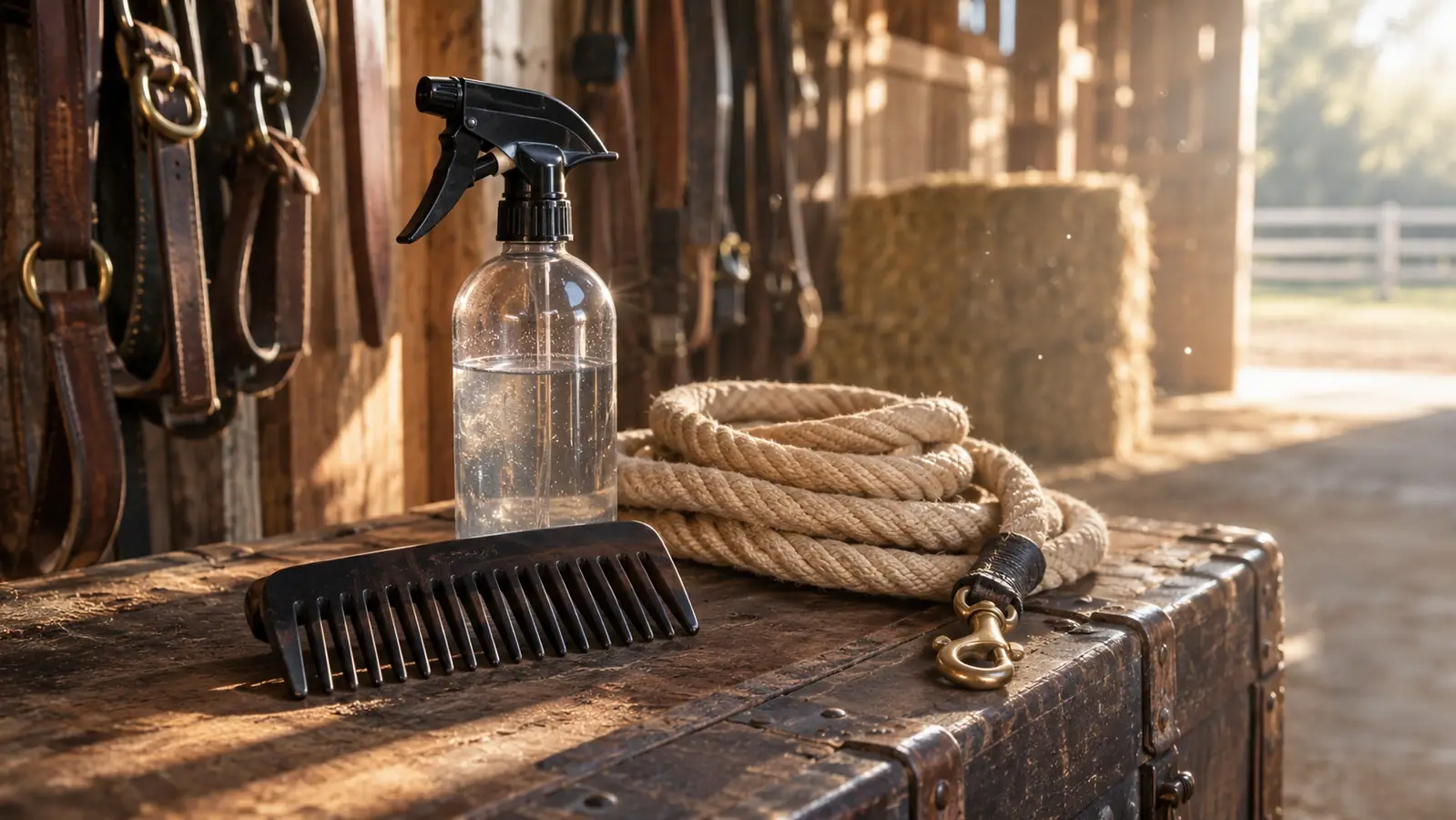
Once the knots are open, switch to a wide tooth comb, and only a wide tooth comb. Hold the tail above your working section so the pull lands on your hand instead of the dock. Comb from the bottom up, an inch at a time. A fine tooth comb or a body brush has no business in a tail, no matter how well the hair is coated.
This is where I decide whether the hair is genuinely tangled or just dry. Dry hair on a thin skinned horse will fight you no matter how careful you are. Damp, coated hair separates. If I find myself leaning into the comb, I stop and spray again. Leaning is how tails get shorter.
Fewer hairs in the comb is the only scoreboard that matters. After a month of this routine my comb comes back nearly empty, and Nadia stopped pinning her ears when I reached for her tail.
Step 4: Work the Tail in Sections and Stay Off the Dock
The dock is the bony base of the tail, and the hair there is short, coarse and slow to grow back. Treat it as a separate job from the long hair below it. Comb the long hair first, all the way down, then come back to the base with your fingers only. Never rake a comb through the short hair at the dock. That is how you get a horse that hates being groomed for the rest of its life.
If a burr or a seed head is caught near the base, work it loose with your fingers and a dab of spray rather than pulling it sideways. Seed heads are the worst offenders in this climate. They grab a strand and lock, and the only way out is to break the burr apart or slide it down the hair. Sliding down takes longer and costs you nothing. Two springs ago Nadia came in off the irrigated pasture with cockleburs braided into the last eight inches of her tail. I cut three of them out with scissors before I thought better of it. Do not do that. Cut a single strand and the burr slides free on its own, and the gap grows back in a month. Cut a whole plug and you are looking at a blunt tail until the next coat.
The mane gets the same bottom up treatment, section by section, from the withers forward. Sahir's mane grows forward and flops to the off side, which means the knots collect where I cannot see them. I part it down the middle first so nothing gets to hide. On a horse with a long mane, ten small sections beat one big handful every time.
Step 5: Protect What You Just Fixed
A detangled tail will re-knot within a week if you turn the horse out in the same conditions and do nothing else. What keeps the work is a light maintenance routine, not another full session. I spray a small amount through the tail every second or third day, work it in with my fingers, and leave the comb in the tote unless there is a real knot to deal with.
During fly season I braid the tail and bag it, and I take the bag off every single day to check the skin underneath. Nadia is sensitive to flies and gets small scabs at the dock if I leave a wet bag on. Absorbine goes on before the braid and never after, because product trapped under a bag is a skin problem waiting to happen.
Show days get a heavier coat, since a polished tail photographs well and the product is earning its keep. Kasim gets the lightest application of my three, because he is not working and I would rather leave some natural oil in an old horse's hair than coat it daily. Two bottles cover me for the year, one on the wash rack and one in the trailer.
What Else Helps
Hair that breaks is often hair that is missing something in the diet. I feed a ration balancer and free choice hay, and I scrub water troughs because a horse that will not drink will not grow tail either. Nutrition is slow. It takes months to see, and it is the difference between a tail that reaches the hocks and one that stalls out at mid cannon no matter what you spray on it.
The other half is mechanical. Clean brushes, a clean comb, a tail bag that actually fits, and a wash rack where the hose reaches. Keep a bottle of Absorbine in the trailer for shows and a second on the wash rack at home, because the bottle sitting in the other barn is the bottle you will not walk over to get. I have used it on the dogs after a muddy trail ride as well, which is what the multi-species label is there for.
One caution. If you pull a tail bag off and find broken skin, crusting or a smell, stop bagging and call your vet. Tail rubbing from pinworms or fly allergies looks like a detangling problem and is not. No spray fixes that, and coating irritated skin makes it worse. Everything in this article assumes healthy skin under the hair.
The bottle that earned its permanent spot on my wash rack
Unscented, 32 ounces, labeled for horses and a barn full of other animals. Wash first, spray from the ends up, fingers before combs, and give it a month before you decide.
Amazon Check Today's Price on Amazon →