
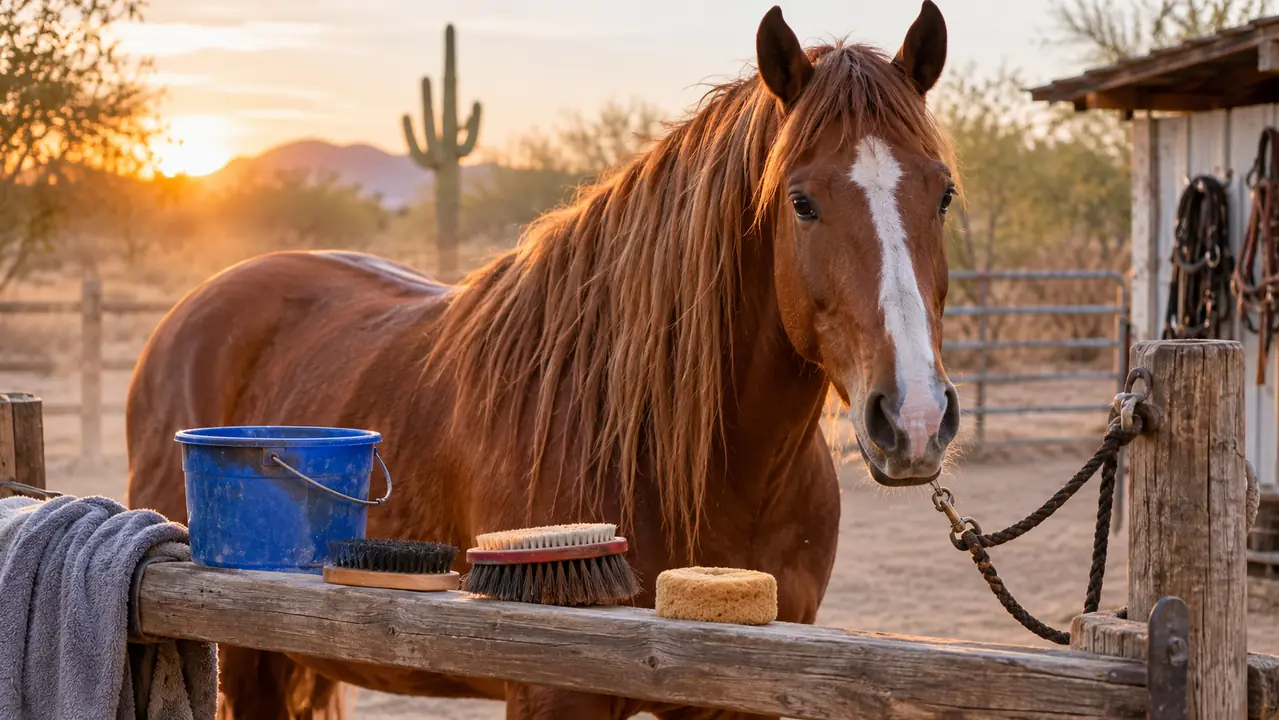
By the end of July, Nadia's tail looks like it has been through a wood chipper. She is a 9-year-old bay Arabian mare, thin-skinned, and she swishes at flies hard enough to whip her own tail hair into knots that take twenty minutes to work out. I have kept Arabians on this place outside Scottsdale for more than 25 years, I do all my own grooming, and I have tried most of the detanglers that come in a spray bottle. Absorbine ShowSheen is the one that has stayed on my wash rack shelf. After months of steady use on three horses, I can tell you where it earns that spot and where it does not.
The short version: it detangles fast, it leaves a slick finish that keeps dust and manure from setting into the hair, and it makes a thin Arabian tail read as fuller than it is. It also builds up if you get heavy-handed, it will not rescue a knot that has already felted, and it makes anything it touches slippery, including the wash rack floor and your saddle pad. More on all of that below.
The Quick Verdict
The bottle I keep buying in the quart. Fast detangling, a finish that survives a week of turnout, and a real shine on a gray coat. Dock it a point for buildup if you over-spray and for how slick it leaves concrete.
Amazon Check Today's Price →One quart carried three horses through a desert summer
If your horse lives outside in dust, the quart is the size that makes sense. Absorbine ShowSheen is unscented, it coats each strand instead of soaking the hair, and a light pass goes a long way. Current pricing and package options are on the Amazon listing.
Amazon Check Today's Price on Amazon →How I've Used It
I keep three Arabians. Sahir is a 14-year-old gray gelding and my main riding horse. Nadia is the 9-year-old bay mare with the thin skin and the fly problem. Kasim is a 22-year-old chestnut gelding, retired, and mostly he holds down the dry lot and waits for his senior feed. All three get the same treatment on the wash rack roughly every ten days in summer and every two to three weeks the rest of the year, plus a full session before any show. I spray Absorbine ShowSheen into the mane from about eight inches back, work it through with my fingers from the roots down, then go over it with a wide-tooth brush. Same on the tail, except I start at the bottom and work up in sections.
On Sahir's gray coat I use it lightly as a finish after the body brush. A gray horse in Maricopa County shows every dust speck and every grass stain, and the slick film the spray leaves makes the next day's dirt come off with two passes of a curry. That was the part that surprised me, because I bought the bottle for the tail, not the body. Two light passes over the barrel and hindquarters before a show, buffed with a towel, and he looks like he has been bathed even when he has not.
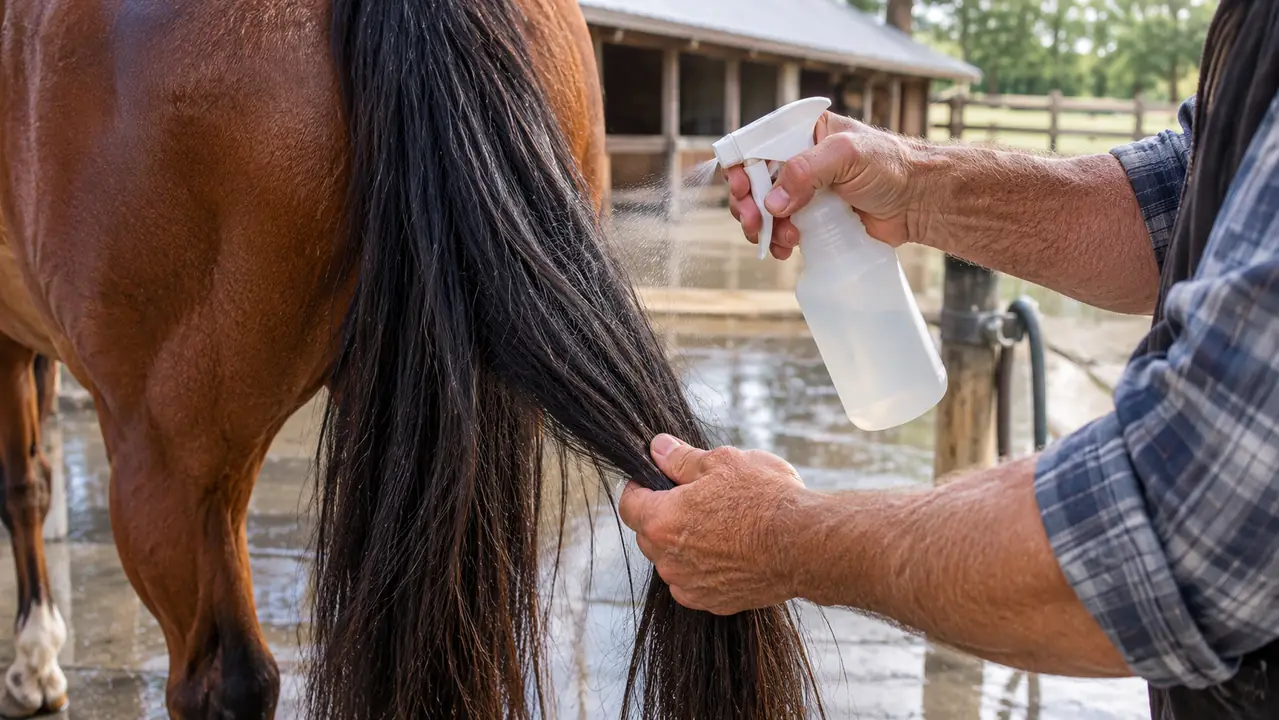
Here is the routine exactly, because dose is where people go wrong with this bottle. I wet nothing. The hair goes in dry, or close to it after a curry. I hold the bottle about eight inches off the tail, give it two pumps on the top third, one on the middle, one near the bottom, then run my fingers through from the bottom up. The whole thing takes about ninety seconds. Then I brush. On June 4, the first genuinely hot day we had this year, I did all three horses in under eight minutes including brushing, which is the number that made me keep the bottle on the shelf. The routine it replaced was a bucket of warm water, a leave-in conditioner I mixed myself, ten minutes of finger-combing per tail, and a fair amount of swearing. That is the comparison I am making here.
Quantity matters more than the label suggests. The first month I used about four times as much as I needed, because the spray comes out fast and I was soaking the hair instead of coating it. Now a 32 fluid ounce quart lasts me most of a summer across three horses, which is the whole reason I buy the quart and not the small bottle. Two or three pumps per section is the right dose. Any more and you are just paying to put product on the concrete.
What It Actually Does to an Arabian Mane and Tail
The listing names silk proteins and pro-vitamins, and says the formula coats each strand and reduces hair breakage by about 40 percent. I cannot measure breakage in my barn, so treat that percentage as the manufacturer's number and not mine. What I can tell you is what the coating does in practice, in dust, on horses that live outside.
Arabian manes are fine, and plenty of them are thin. Nadia's mane will not grow past about six inches and never has. This spray does not make hair grow. What it does is make each strand slick enough that the hair lays down together instead of frizzing out sideways, and that reads as a fuller mane from ten feet away. The tail is the same story. A tail on a horse that lives outside in dust collects burrs, shavings and manure, and once that material works into the hair it felts. A coated strand releases all of it with a flick of the brush.
If you want a test you can run on your own horse, try this. Take a clean section of mane, give it one pass, work it through with your fingers, and let it dry for ten minutes. Then try to lay that section flat against the neck. On Nadia it stays where I put it. The untreated section beside it springs back into a frizz the second I take my hand away. That is the coating doing its job: it slickens the outside of the strand so hair slides against hair instead of catching on itself. It also means the product sits on the outside of the hair, which is exactly why the shampoo every third or fourth use matters. Anything that lives on the surface has to come off eventually or it stacks up.
There is a real limit here, and it is worth saying plainly. This is a surface product. It sits on the hair. It is not a conditioner that soaks in and repairs a tail that has already been rubbed bald by a horse with a fly allergy or a habit of rubbing on the fence. If your mare has scrubbed the bottom third of her tail off, no spray bottle fixes that. You fix the itch first, then you use something like this to keep the new hair from knotting while it comes back.
Where It Held Up Over a Desert Summer
The honest test out here is the monsoon, when the wind picks up in late afternoon and puts a fine grit into everything, including the hair on a horse standing in a dry lot. A tail that has been coated holds that grit on the surface instead of working it into the strands. I was brushing out less, not more, which is the opposite of what I expected. Kasim, who is 22 and does not love being handled as much as he used to, gets through a tail session in about four minutes now instead of the ten it used to take.
The clearest single test came on a show weekend in late September, after a monsoon cell moved through overnight and left a quarter inch of grit on everything in the dry lot. I had sprayed all three tails the Thursday before. I walked out Friday morning expecting to spend the whole morning brushing before we loaded. Kasim's tail had maybe a dozen pieces of debris in it. Nadia's had more, because she is the one who swishes, but it came out with a flick of the brush and no pulling at all. That saved me close to two hours on a morning when I did not have two hours to give. The same pattern held all summer: the spray bought back time on the days the weather took time away.
Show prep is where the shine shows up most. Sahir is a gray, and gray plus a slick finish under arena lights looks like a different horse than gray plus a clean but flat coat. I use it on the body, mane and tail before a regional open show, then cover the tail with a bag for the trailer ride. He comes out of the trailer with the tail still hanging straight instead of pouffed into a haystack, which is not something I could say for the two detanglers I used before this one.
Two small things I did not expect to care about. First, it is unscented. I have stood next to horses wearing detanglers that smell like a candle store, and in a closed trailer that is a long ride. Second, the manufacturer lists it as safe across horses, cattle, dogs, llamas, pigs, camels, goats, alpacas and sheep. I have not tested that list, but I have used it on a dog tail and lived to tell about it.
Where It Fell Short
Buildup is the one thing that will turn you against this bottle. Go heavy three sessions in a row and the hair starts to feel tacky rather than slick, and tacky hair collects dust instead of shedding it. I got there in my first month. The fix is not complicated, which is to wash the tail with real shampoo every third or fourth application and start over with a light hand. If you only ever spray and never wash, you will decide this product is worse than it is.
The buildup arrives quietly. It will not happen after one heavy session. It happens across three or four, and the first sign is not visual, it is tactile. You run your hand down the tail and it feels slightly grippy instead of slick, and the brush starts catching again in the same spots it used to glide through. My mistake early on was spraying again to fix the catching, which made the whole thing worse and cost me a wash anyway. Now there is a line on the tack room whiteboard: shampoo the tail before the brush starts catching, not after. That one note has saved me more hair than any product change I have made in twenty years.
Slippery is the second thing. Anything this spray touches becomes slick, and that includes the concrete under the wash rack and your hands. I watched a barn helper go down on a wet patch and I have been careful ever since. Keep the spray on the horse, hose the floor after, and do not use it on the saddle area, the girth area or anywhere a pad sits. A pad that slides is a safety problem, not a grooming annoyance.
Third, it does not touch a knot that has already set. If you have a felted burr ball at the base of the tail, spraying it and pulling will cost you hair. Work that out with your fingers and a pick first, a little at a time, and use the spray afterward to keep it from coming back. This is a preventive and a finisher, not a rescue tool.
What I Liked
- Detangles a fine Arabian mane and tail in a fraction of the time a plain brush takes
- The slick finish keeps desert dust and manure on the surface instead of worked into the hair
- One 32 fluid ounce quart lasts most of a summer across three horses at two to three pumps per section
- Unscented, which matters in a closed trailer
- Gives a visible shine on a gray coat under show lights, not just on manes and tails
- Manufacturer states it reduces hair breakage by about 40 percent by coating each strand
Where It Falls Short
- Buildup turns tacky if you use it more than a couple of sessions in a row without shampooing
- Makes concrete, hands and saddle pads genuinely slippery
- Will not loosen a knot that has already felted, despite what a hasty reading of the label suggests
- No substitute for actual conditioning on a tail that has been rubbed thin by fly allergy
One quart got three Arabians through a desert summer, and the tail I bought it for is still attached, still full, and brushes out in four minutes instead of twenty.
Who This Is For
This is for the person with a horse that lives outside in dirt, dust or mud and comes in with a mane and tail that look like they were used to sweep the paddock. It suits fine-haired breeds especially, because the coating does more visible work on a thin Arabian mane than on a thick draft mane that already lays down on its own. It suits anyone doing their own grooming who wants fewer minutes per horse. And it suits someone showing on a budget, because a light body pass gives a shine that reads as a bath without the two hours of washing and drying a gray horse actually requires. It also suits a small barn where the same person grooms the same three horses every day, because dose control becomes second nature fast. After a couple of weeks I could tell by feel when I had two pumps in hand and when I had gotten greedy.
Who Should Skip It
Skip it if your horse has already rubbed its tail raw from a fly allergy or a fence habit. Fix the cause before you buy a detangler, or you will be spraying a product onto hair that is coming out anyway. Skip it if you want one bottle that both detangles and conditions deeply, because this one sits on the surface and does not repair. And skip it if you are the type to spray everything, every day, without washing in between. You will hit the tacky stage in about two weeks and blame the bottle for it. Absorbine makes a good product here; the limit is the hand holding it.
If your horse lives in dust, buy the quart, not the small bottle
Two or three pumps per section, a light body pass before a show, and a real shampoo every third or fourth use. That routine got three Arabians through a desert summer on one quart. Current pricing is on the Amazon listing.
Amazon Check Today's Price on Amazon →