
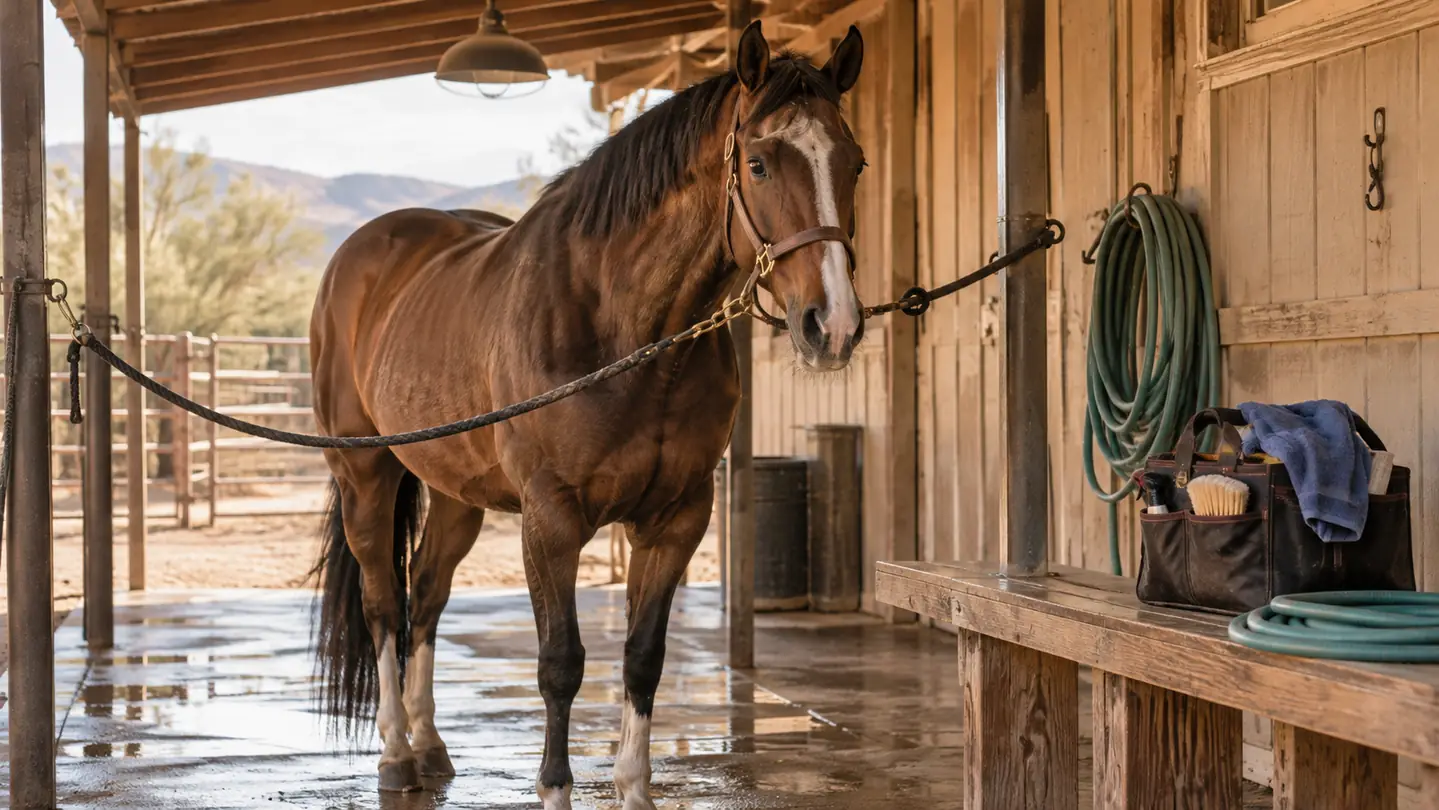
I have groomed three Arabians through twenty-five Arizona summers and the routine itself has not changed much. What changed is how much time I used to spend walking. My brushes lived on hooks by the tack room door, the hoof pick stayed in the trailer, and the sweat scraper turned up three days after I needed it. Grooming Sahir took forty minutes, and half of that was hunting.
Then I stopped scattering tools and started keeping one bag by the wash rack. The Weaver Equine Horse Grooming Kit is what ended up in that spot. Seven pieces, a tote with six outer pockets, and webbing handles that survive being dragged across a barn aisle. It weighs under three pounds, so carrying it out to the paddock gate is not a chore. What follows is the exact order I use on all three horses, and where each piece earns its place.
Seven pieces, one bag, nothing left in the tack room
The Weaver Equine kit keeps the hoof pick, comb, sweat scraper and brushes together in a tote with six outer pockets, so the tool you need is already in your hand.
Amazon Check Today's Price on Amazon →Step 1: Put the kit where you groom, and empty every pocket once
Most grooming problems are really logistics problems. If the bag is in the tack room and the horse is at the wash rack, you will skip the part you do not want to do. I set the tote on the bench at the end of my wash rack, or hang it from a fence rail when I am working in the dry lot. Once it has a home, the routine has a home.
For the first week I kept the tote on the bench and made a mental note every time I had to walk back for something. Thursday it was the hoof pick, left in the trailer after a trail ride. Saturday it was the comb, still in the tack room from the show the weekend before. By the end of that week the bag had a fixed spot and I had stopped losing things, which sounds small until you add up the trips. A tote that weighs under three pounds is light enough that you will actually carry it out to the paddock gate instead of leaving it on the bench, and the webbing handles mean you can hook an arm through it while your other hand is on a lead rope.
Before the first use, take everything out and put it back in. The Weaver Equine kit carries a hoof pick, a comb, a sweat scraper and the brushes, and the six outer pockets mean each piece has a spot you can reach without unzipping anything. Learn which pocket holds what while the horse is still in the stall. You do not want to be patting around blind with a tied horse leaning on you.
Then look at the horse before you look at the tools. Run a flat hand over the back, down each shoulder and along the spine. You are feeling for heat, swelling, a new scrape, a burr tangled in the tail. Grooming is the cheapest exam you will ever give a horse, and it only works if you slow down for the first thirty seconds.
Step 2: Loosen the dust before you try to brush it off
In Scottsdale we get two kinds of dirt. There is the fine powder that settles overnight and the grit that arrives with a late summer dust storm and works its way down to the skin. Both of them need to be lifted before they can be carried away, which is why the first pass is not a beauty pass.
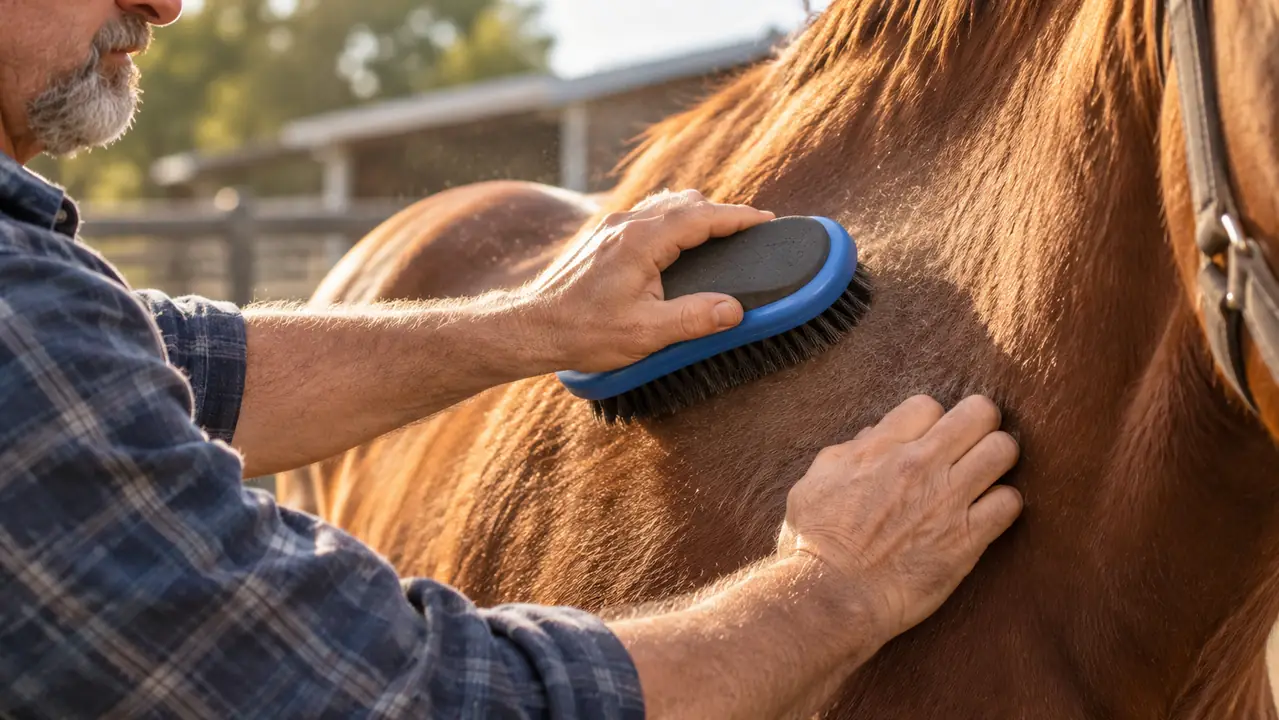
Start with the firmest brush in the kit and work in short circles over the big muscle groups: the shoulder, the barrel, the hindquarter. Skip the spine, the point of the hip, and anywhere the bone sits close under the skin. On Nadia I go lighter on the flank because she will hump up and step away, and a horse that is stepping away is not getting groomed.
One August the monsoon came in early and dropped a layer of grit on everything, including three horses standing under a shed row that only blocks wind from one direction. Sahir looked like he had been rolled in a sandbox. The temptation is to grab the softest brush because the horse looks so bad, and that is exactly backwards. A soft brush on a gritty coat polishes the dirt down into the hair instead of lifting it off. I did it that way for two seasons before I understood why he never came out looking clean. Now the firm brush goes first every time, dust storm or not.
Do not expect this pass to make anything look clean. Sahir is gray, which means every speck of dust shows, and after step two he still looks dingy. That is correct. The loosening comes first, the lifting comes second, and the shine at the end is the result of doing both in order.
Step 3: Brush the coat in the direction the hair grows
Now switch to a softer brush and use long, flat strokes with the hair rather than against it. Work from the neck back toward the tail, and keep your wrist loose. Short choppy strokes just rearrange the dust. Long ones push it off the coat and onto the ground where it belongs.
Nadia is nine and thin-skinned, and she will tell you in about four seconds if a brush is too harsh. She is right often enough that I listen. On her I use the lightest brush in the bag and let the pressure come from the wrist instead of the shoulder. Kasim, at twenty-two, is the opposite. He wants a firm hand and will lean into it, which is fine as long as you remember he is old and not a scratching post.
The face gets its own pass at the very end of this step, with the softest thing in the kit or just a bare hand. Eyes, ears, muzzle, the bony ridge under the jaw. Arabians have a small, fine head and a lot of opinion about it, so keep the strokes short and stop when the horse tells you to stop.
Step 4: Comb the mane, forelock and tail from the ends up
Arabians have a reputation for thin manes and they earn it. That reputation is one reason I am careful with the comb in this kit. Hold the hair in one hand above where you are working, then comb the last few inches free before you move up. Working top down on a knot turns a tangle into a bald spot, and it takes a season to grow back.
The forelock gets the same treatment with more patience, because it is the part everyone sees and the part that catches burrs first. If a knot will not release with fingers and comb, work it out with your hands and leave the comb out of it entirely.
Nadia's mane is the finest of the three and also the one that tangles worst, because fine hair knots on itself where coarse hair slides past. If it has been windy I mist it with plain water and work the last two inches with my fingers before the comb ever touches it. A good combing is one where I do not hear a single rip. Kasim's mane is thicker and takes about a minute. Sahir picks up grass seed in his forelock every June, and that is a fingers-only job, because the seed works down to the skin and a comb takes hair with it on the way out.
Tails I comb far less often than people expect. A tail combed out every single day thins out fast, and a wet tail is worse. My rule is a full comb-out once a week unless there is something actually stuck in it. That is a rule about the horse, not about the comb, and it applies whether the comb came from the Weaver Equine tote or from a drawer in the house.
This is also the step where I check the sheath and under the jaw on the geldings, and run a hand under the mane to feel for ticks after a trail ride. Small habit, saves a vet call.
Grooming three horses went from ninety minutes of walking back and forth to about fifty minutes of actual work. Same horses, same coats, fewer trips.
Step 5: Pick the hooves, then rinse and scrape
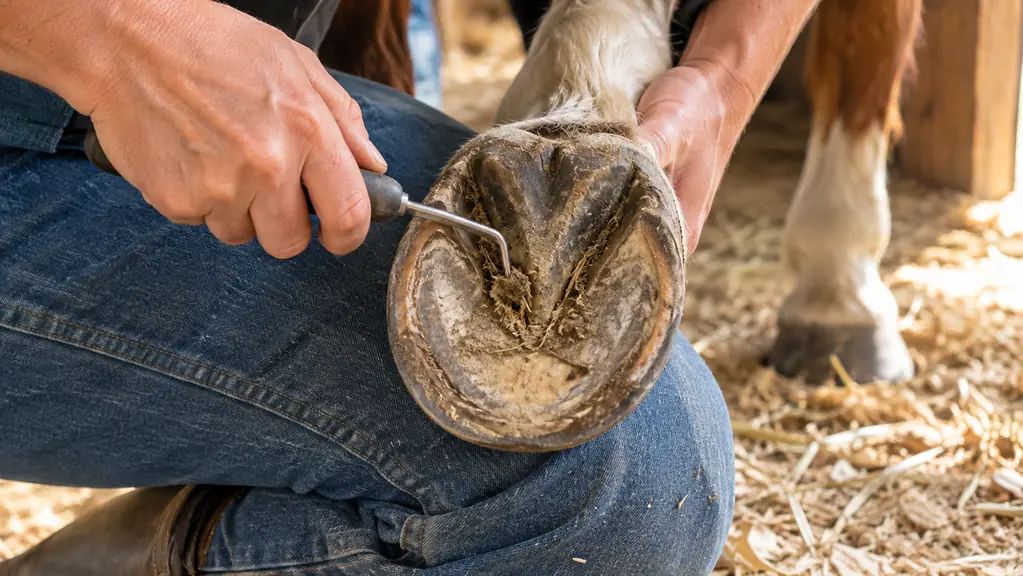
Hooves come last because everything you have done up to now has knocked dirt onto the ground near the horse's feet. Kasim is retired and barefoot, and my farrier is out every six weeks, so I pick him out daily and pay attention to what comes out. Packed dirt that smells wrong or a dark line along the white line is a phone call, not a grooming problem.
Kasim's feet are the reason I stopped treating hoof picking as a chore. He is twenty-two, barefoot, and in dry heat his soles go hard and his frogs pack with grit after every session in the arena. With the farrier on a six-week schedule, I am the one who sees his feet on the days in between, which makes me the early warning system. I pick all four before I ride and all four after, and I look at what comes out rather than only at the hoof. Dry grit is normal. A soft spot, a dark line, or anything that smells wrong is a phone call that same day, not next week.
Stand to the side, not in front of the leg, and run your hand down the cannon bone before you ask for the foot. Clean from the heel toward the toe and be gentle around the frog. A hoof pick is a scraping tool, not a digging tool, and the sole is not a place to prove how strong your wrist is.
If the horse is sweaty, hose or sponge him off and then use the sweat scraper. Work it in the direction of the hair with a light, flat pull, and keep going over the same area until it stops bringing water off. A scraper used hard against the grain just irritates a thin-skinned horse. Nadia tolerates the scraper on her shoulder and neck and would prefer I skip her hindquarters entirely, so I do.
What Else Helps
The kit covers the brushing, the combing, the hooves and the rinse. Two things it does not cover and you should have on the shelf anyway: a hoof conditioner for a barefoot older gelding in dry desert heat, and a fly wipe for a thin-skinned mare in fly season. A stack of clean rags is the third item. You will use them more than you expect, especially on a gray horse.
Rags are the thing I under-bought for years. I keep a stack of cut-up towels in the tack room and a couple folded into the tote's outer pockets, and on a gray horse they go twice as fast as you would guess. The kit's pieces are plastic and rubber and the bag carries a satisfaction guarantee behind it, but no brush survives being left out in the sun, so the rags and the shade do as much for the equipment as they do for the horse.
Timing matters as much as tools out here. I groom early, before the sun clears the barn roof, because a horse that is already hot and bothered is a horse that will not stand still for his tail. I also keep the tote out of direct sun. Year after year of Arizona UV will cook anything left on a fence post all afternoon.
One more habit worth building: put the tools back in the tote before you turn the horse out, not after. The horses that get turned out first are the ones whose hoof picks go missing.
The bag that stays by the wash rack
Seven pieces, six outer pockets, and a tote that survives being dragged across a barn aisle. Start with the Weaver Equine kit and add the conditioner and fly wipe as your horses tell you what they need.
Amazon Check Today's Price on Amazon →